New MCP server — Bring vulnerability intelligence into your AI
Back to feed

CVE-2021-47230

NVDCIRCLENISA

EUVD-2021-33878 · Published May 21, 2024

In the Linux kernel, the following vulnerability has been resolved: KVM: x86: Immediately reset the MMU context when the SMM flag is cleared Immediately reset the MMU context when the vCPU's SMM flag is cleared so that the SMM flag in the MMU role is always synchronized with the vCPU's flag. If RSM fails (which isn't correctly emulated), KVM will bail without calling post_leave_smm() and leave the MMU in a bad state. The bad MMU role can lead to a NULL pointer dereference when grabbing a shadow page's rmap for a page fault as the initial lookups for the gfn will happen with the vCPU's SMM flag (=0), whereas the rmap lookup will use the shadow page's SMM flag, which comes from the MMU (=1). SMM has an entirely different set of memslots, and so the initial lookup can find a memslot (SMM=0) and then explode on the rmap memslot lookup (SMM=1). general protection fault, probably for non-canonical address 0xdffffc0000000000: 0000 [#1] PREEMPT SMP KASAN KASAN: null-ptr-deref in range [0x0000000000000000-0x0000000000000007] CPU: 1 PID: 8410 Comm: syz-executor382 Not tainted 5.13.0-rc5-syzkaller #0 Hardware name: Google Google Compute Engine/Google Compute Engine, BIOS Google 01/01/2011 RIP: 0010:__gfn_to_rmap arch/x86/kvm/mmu/mmu.c:935 [inline] RIP: 0010:gfn_to_rmap+0x2b0/0x4d0 arch/x86/kvm/mmu/mmu.c:947 Code: <42> 80 3c 20 00 74 08 4c 89 ff e8 f1 79 a9 00 4c 89 fb 4d 8b 37 44 RSP: 0018:ffffc90000ffef98 EFLAGS: 00010246 RAX: 0000000000000000 RBX: ffff888015b9f414 RCX: ffff888019669c40 RDX: 0000000000000000 RSI: 0000000000000001 RDI: 0000000000000001 RBP: 0000000000000001 R08: ffffffff811d9cdb R09: ffffed10065a6002 R10: ffffed10065a6002 R11: 0000000000000000 R12: dffffc0000000000 R13: 0000000000000003 R14: 0000000000000001 R15: 0000000000000000 FS: 000000000124b300(0000) GS:ffff8880b9b00000(0000) knlGS:0000000000000000 CS: 0010 DS: 0000 ES: 0000 CR0: 0000000080050033 CR2: 0000000000000000 CR3: 0000000028e31000 CR4: 00000000001526e0 DR0: 0000000000000000 DR1: 0000000000000000 DR2: 0000000000000000 DR3: 0000000000000000 DR6: 00000000fffe0ff0 DR7: 0000000000000400 Call Trace: rmap_add arch/x86/kvm/mmu/mmu.c:965 [inline] mmu_set_spte+0x862/0xe60 arch/x86/kvm/mmu/mmu.c:2604 __direct_map arch/x86/kvm/mmu/mmu.c:2862 [inline] direct_page_fault+0x1f74/0x2b70 arch/x86/kvm/mmu/mmu.c:3769 kvm_mmu_do_page_fault arch/x86/kvm/mmu.h:124 [inline] kvm_mmu_page_fault+0x199/0x1440 arch/x86/kvm/mmu/mmu.c:5065 vmx_handle_exit+0x26/0x160 arch/x86/kvm/vmx/vmx.c:6122 vcpu_enter_guest+0x3bdd/0x9630 arch/x86/kvm/x86.c:9428 vcpu_run+0x416/0xc20 arch/x86/kvm/x86.c:9494 kvm_arch_vcpu_ioctl_run+0x4e8/0xa40 arch/x86/kvm/x86.c:9722 kvm_vcpu_ioctl+0x70f/0xbb0 arch/x86/kvm/../../../virt/kvm/kvm_main.c:3460 vfs_ioctl fs/ioctl.c:51 [inline] __do_sys_ioctl fs/ioctl.c:1069 [inline] __se_sys_ioctl+0xfb/0x170 fs/ioctl.c:1055 do_syscall_64+0x3f/0xb0 arch/x86/entry/common.c:47 entry_SYSCALL_64_after_hwframe+0x44/0xae RIP: 0033:0x440ce9

Technologies

Linux Linux Kernel

Weaknesses

CWE-476

CVSS scores

  • v3.16.6CVSS:3.1/AV:L/AC:L/PR:L/UI:R/S:U/C:N/I:H/A:H

MITRE ATT&CK

Inferred

Where this vulnerability fits in an attack

Privilege Escalation

References

Potentially impacted assets

See if this affects your attack surface

Latest trending attack

Criticalyesterday

Google Brotli decoder - Remote Code Execution via compressed requests (Exploitation Check)

This control is the second step of the Patrowl response to CVE-2026-111497 (Node2Shell). It complements the first control of 22 October 2026, which focused on the Node.js runtime, and does not replace it. Why a second control CVE-2026-111497 is an out-of-bounds write in the Google Brotli decoder, the library that decompresses Brotli ("br") data. It was first published as a Node.js vulnerability, because Node.js bundles this decoder. Later publications showed that the flaw is in the library itself. Every product that embeds an affected version of the decoder is concerned, whatever its language or vendor. A public proof of concept demonstrates code execution. Any server that decompresses request bodies sent with "Content-Encoding: br" exposes the decoder to unauthenticated attackers. Known cases include Express 5 and NestJS 11 on Node.js, Koa and Fastify setups, Bun, Envoy and Istio with request decompression enabled, and any application or reverse proxy that decodes Brotli request bodies with an affected library. The flaw also works in the other direction. A malicious server can compromise an unpatched client that decodes a Brotli response, for example Node.js fetch(), Python clients (requests, httpx, aiohttp, Scrapy) with the Brotli or brotlicffi package, or libcurl builds with Brotli support. What this control checks Patrowl sends small, valid Brotli-compressed requests to each asset and observes whether the server decodes them. The check does not depend on the technology: it detects the behaviour, whatever the stack behind it. These requests are what any legitimate client could send. They never reach the vulnerable code path and cannot affect the availability of the service. How to read the result Potentially impacted means the asset decodes Brotli request bodies: the attack surface is exposed. It does not confirm that the asset is vulnerable. The version of the Brotli decoder in use is not visible from the outside. This check covers applications that parse request bodies on their root path. A Not impacted result does not rule out exposure on other routes, nor on the client side. Checking the versions on the servers remains the only exhaustive verification. Affected and fixed versions Google Brotli 1.0.3 to 1.2.0 are affected, fixed in 1.0.10, 1.1.1 and 1.2.1. Fixed releases of the main products embedding it: Node.js 22.23.4, 24.22.1 and 26.12.1 (end-of-life lines 20.x and older and 25.x receive no fix), Bun 1.4.4, Envoy 1.37.8, 1.38.6, 1.39.3 and 1.40.0, Istio 1.29.9, 1.30.6 and 1.31.2, Python Brotli 1.2.1 and brotlicffi 1.2.1.0. Products that link against the system library depend on the Brotli package of the Linux distribution. Recommendations Update every component that embeds the Brotli decoder (only real fix). Start with the assets flagged by this control. Restart the processes after the update. Rebuild containers, single-executable applications and appliances that bundle an affected runtime or library. Reduce the exposure until the update is deployed. Reject requests with "Content-Encoding: br" at the reverse proxy, load balancer or WAF, case-insensitively and including lists such as "gzip, br". On Envoy and Istio, disable request decompression for Brotli. Review outbound calls. List the features that fetch content from servers you do not control, and patch the services that host them first.

Take 15 minutes to discover our platform with our experts

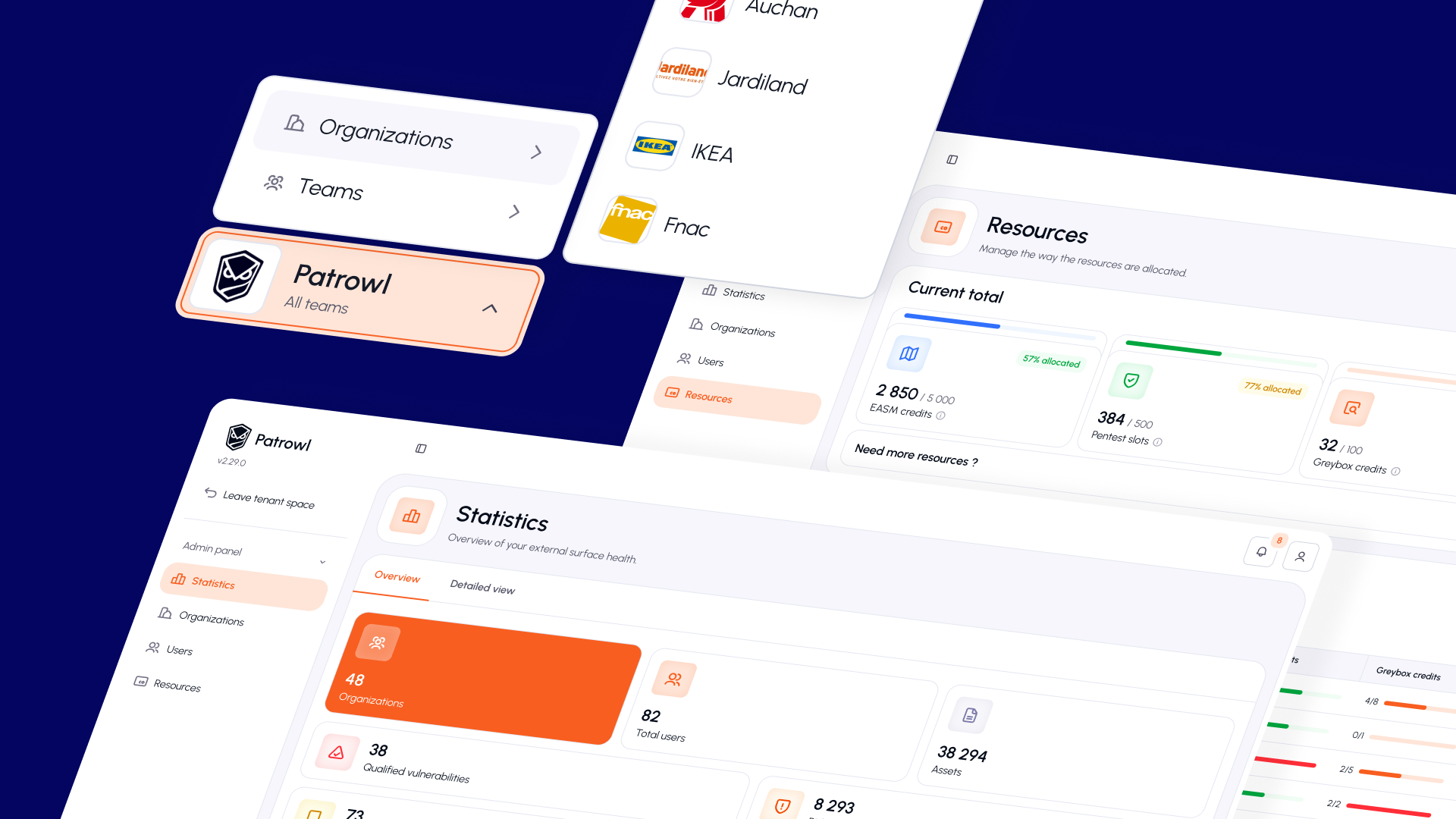
Patrowl Intel platform screenshot