New MCP server — Bring vulnerability intelligence into your AI
Back to feed

CVE-2023-28840

ExploitedNVDCIRCLENISA

EUVD-2023-1150 · Published Apr 4, 2023

Docker Swarm encrypted overlay network may be unauthenticated

Moby is an open source container framework developed by Docker Inc. that is distributed as Docker, Mirantis Container Runtime, and various other downstream projects/products. The Moby daemon component (dockerd), which is developed as moby/moby is commonly referred to as Docker.

Swarm Mode, which is compiled in and delivered by default in dockerd and is thus present in most major Moby downstreams, is a simple, built-in container orchestrator that is implemented through a combination of SwarmKit and supporting network code.

The overlay network driver is a core feature of Swarm Mode, providing isolated virtual LANs that allow communication between containers and services across the cluster. This driver is an implementation/user of VXLAN, which encapsulates link-layer (Ethernet) frames in UDP datagrams that tag the frame with a VXLAN Network ID (VNI) that identifies the originating overlay network. In addition, the overlay network driver supports an optional, off-by-default encrypted mode, which is especially useful when VXLAN packets traverses an untrusted network between nodes.

Encrypted overlay networks function by encapsulating the VXLAN datagrams through the use of the IPsec Encapsulating Security Payload protocol in Transport mode. By deploying IPSec encapsulation, encrypted overlay networks gain the additional properties of source authentication through cryptographic proof, data integrity through check-summing, and confidentiality through encryption.

When setting an endpoint up on an encrypted overlay network, Moby installs three iptables (Linux kernel firewall) rules that enforce both incoming and outgoing IPSec. These rules rely on the u32 iptables extension provided by the xt_u32 kernel module to directly filter on a VXLAN packet's VNI field, so that IPSec guarantees can be enforced on encrypted overlay networks without interfering with other overlay networks or other users of VXLAN.

Two iptables rules serve to filter incoming VXLAN datagrams with a VNI that corresponds to an encrypted network and discards unencrypted datagrams. The rules are appended to the end of the INPUT filter chain, following any rules that have been previously set by the system administrator. Administrator-set rules take precedence over the rules Moby sets to discard unencrypted VXLAN datagrams, which can potentially admit unencrypted datagrams that should have been discarded.

On Red Hat Enterprise Linux and derivatives such as CentOS and Rocky, the xt_u32 module has been:

These rules are not created when xt_u32 is unavailable, even though the container is still attached to the network.

Impact

Encrypted overlay networks on affected configurations silently accept cleartext VXLAN datagrams that are tagged with the VNI of an encrypted overlay network. As a result, it is possible to inject arbitrary Ethernet frames into the encrypted overlay network by encapsulating them in VXLAN datagrams.

The injection of arbitrary Ethernet frames can enable a Denial of Service attack. A sophisticated attacker may be able to establish a UDP or TCP connection by way of the container’s outbound gateway that would otherwise be blocked by a stateful firewall, or carry out other escalations beyond simple injection by smuggling packets into the overlay network.

Patches

Patches are available in Moby releases 23.0.3, and 20.10.24. As Mirantis Container Runtime's 20.10 releases are numbered differently, users of that platform should update to 20.10.16.

Workarounds

  • Close the VXLAN port (by default, UDP port 4789) to incoming traffic at the Internet boundary (see GHSA-vwm3-crmr-xfxw) to prevent all VXLAN packet injection.
  • Ensure that the xt_u32 kernel module is available on all nodes of the Swarm cluster.

Background

  • #43382 partially discussed this concern, but did not consider the security implications.
  • Mirantis FIELD-5788 essentially duplicates #43382, and was created six months earlier; it similarly overlooked the security implications.
  • #45118 is the ancestor of the final patches, and was where the security implications were discovered.

Related

Technologies

Mobyproject MobyDocker Docker

Weaknesses

CWE-755CWE-636CWE-420CWE-203

CVSS scores

  • v3.17.5CVSS:3.1/AV:N/AC:H/PR:N/UI:N/S:C/C:H/I:N/A:L

MITRE ATT&CK

Inferred

Where this vulnerability fits in an attack

Initial Access

References

Potentially impacted assets

See if this affects your attack surface

Latest trending attack

Criticaltoday

Google Brotli decoder - Remote Code Execution via compressed requests (Exploitation Check)

This control is the second step of the Patrowl response to CVE-2026-111497 (Node2Shell). It complements the first control of 22 October 2026, which focused on the Node.js runtime, and does not replace it. Why a second control CVE-2026-111497 is an out-of-bounds write in the Google Brotli decoder, the library that decompresses Brotli ("br") data. It was first published as a Node.js vulnerability, because Node.js bundles this decoder. Later publications showed that the flaw is in the library itself. Every product that embeds an affected version of the decoder is concerned, whatever its language or vendor. A public proof of concept demonstrates code execution. Any server that decompresses request bodies sent with "Content-Encoding: br" exposes the decoder to unauthenticated attackers. Known cases include Express 5 and NestJS 11 on Node.js, Koa and Fastify setups, Bun, Envoy and Istio with request decompression enabled, and any application or reverse proxy that decodes Brotli request bodies with an affected library. The flaw also works in the other direction. A malicious server can compromise an unpatched client that decodes a Brotli response, for example Node.js fetch(), Python clients (requests, httpx, aiohttp, Scrapy) with the Brotli or brotlicffi package, or libcurl builds with Brotli support. What this control checks Patrowl sends small, valid Brotli-compressed requests to each asset and observes whether the server decodes them. The check does not depend on the technology: it detects the behaviour, whatever the stack behind it. These requests are what any legitimate client could send. They never reach the vulnerable code path and cannot affect the availability of the service. How to read the result Potentially impacted means the asset decodes Brotli request bodies: the attack surface is exposed. It does not confirm that the asset is vulnerable. The version of the Brotli decoder in use is not visible from the outside. This check covers applications that parse request bodies on their root path. A Not impacted result does not rule out exposure on other routes, nor on the client side. Checking the versions on the servers remains the only exhaustive verification. Two situations are possible. When the decoding is done by your own application or reverse proxy, identify the component and update it. If an update is not possible right away, reject requests with "Content-Encoding: br" at the reverse proxy or WAF. When the asset is hosted on a managed platform or behind a CDN (for example Platform.sh, Upsun or Fastly), the decoding may be done by the provider's edge router, in front of your application. You cannot patch it yourself, but this router handles all the traffic of your site. Ask your provider to confirm that its edge components are patched against CVE-2026-111497. Assets hosted on a managed platform or behind a CDN carry the tag "paas: platform.sh" or "cdn: fastly" in the asset view: for these assets, the Brotli decoding is done by the provider's edge router, in front of your application, and only the provider can patch it. Affected and fixed versions Google Brotli 1.0.3 to 1.2.0 are affected, fixed in 1.0.10, 1.1.1 and 1.2.1. Fixed releases of the main products embedding it: Node.js 22.23.4, 24.22.1 and 26.12.1 (end-of-life lines 20.x and older and 25.x receive no fix), Bun 1.4.4, Envoy 1.37.8, 1.38.6, 1.39.3 and 1.40.0, Istio 1.29.9, 1.30.6 and 1.31.2, Python Brotli 1.2.1 and brotlicffi 1.2.1.0. Products that link against the system library depend on the Brotli package of the Linux distribution. Recommendations Update every component that embeds the Brotli decoder (only real fix). Start with the assets flagged by this control. Restart the processes after the update. Rebuild containers, single-executable applications and appliances that bundle an affected runtime or library. Reduce the exposure until the update is deployed. Reject requests with "Content-Encoding: br" at the reverse proxy, load balancer or WAF, case-insensitively and including lists such as "gzip, br". On Envoy and Istio, disable request decompression for Brotli. Contact your edge provider about the status of the pathing (Fastly / Plateform.sh) Review outbound calls. List the features that fetch content from servers you do not control, and patch the services that host them first.

Take 15 minutes to discover our platform with our experts

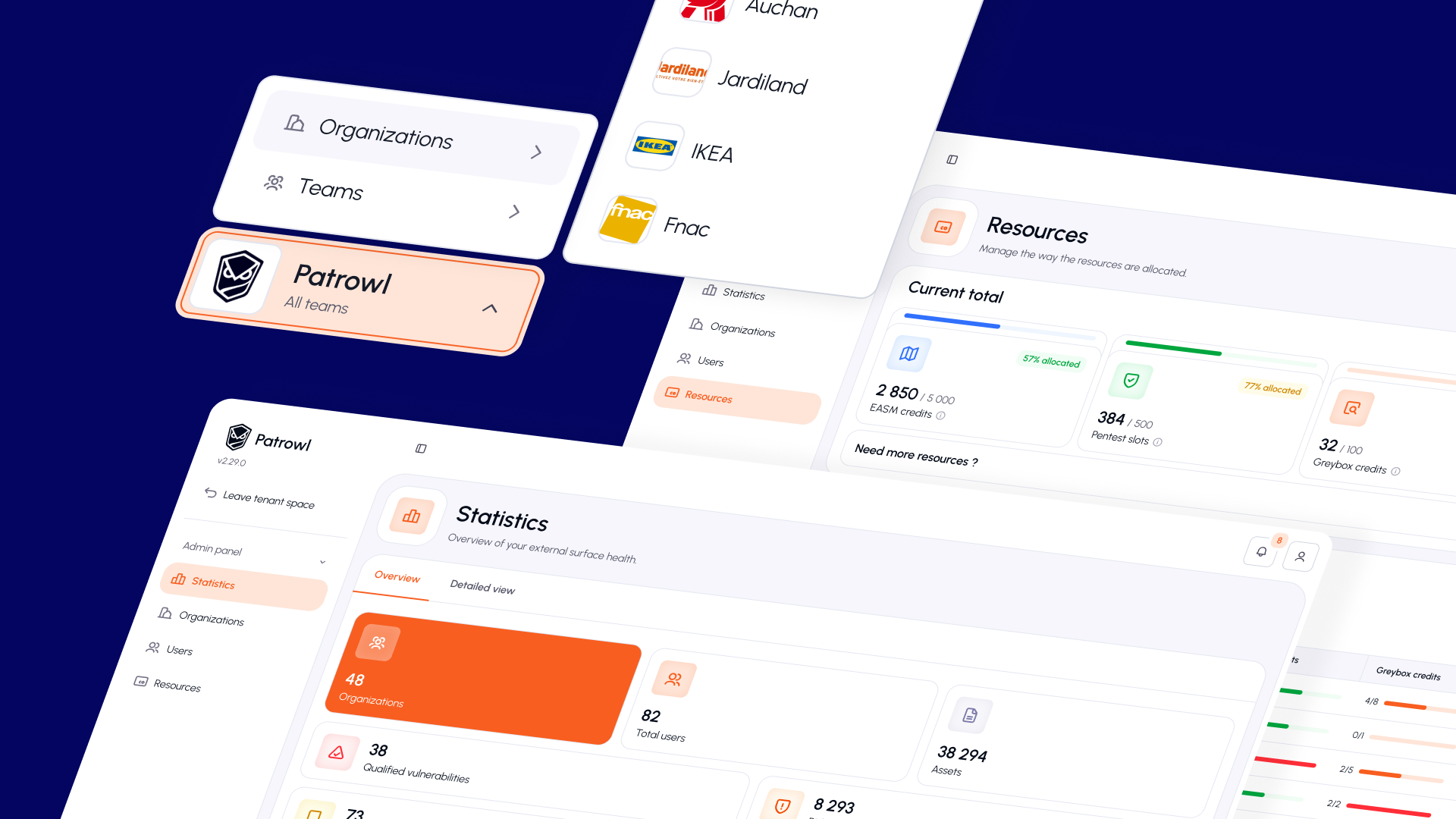
PatrowlIntel platform screenshot