New MCP server — Bring vulnerability intelligence into your AI
Back to feed

CVE-2023-52784

NVDCIRCLENISA

EUVD-2023-59501 · Published May 21, 2024

In the Linux kernel, the following vulnerability has been resolved: bonding: stop the device in bond_setup_by_slave() Commit 9eed321cde22 ("net: lapbether: only support ethernet devices") has been able to keep syzbot away from net/lapb, until today. In the following splat [1], the issue is that a lapbether device has been created on a bonding device without members. Then adding a non ARPHRD_ETHER member forced the bonding master to change its type. The fix is to make sure we call dev_close() in bond_setup_by_slave() so that the potential linked lapbether devices (or any other devices having assumptions on the physical device) are removed. A similar bug has been addressed in commit 40baec225765 ("bonding: fix panic on non-ARPHRD_ETHER enslave failure") [1] skbuff: skb_under_panic: text:ffff800089508810 len:44 put:40 head:ffff0000c78e7c00 data:ffff0000c78e7bea tail:0x16 end:0x140 dev:bond0 kernel BUG at net/core/skbuff.c:192 ! Internal error: Oops - BUG: 00000000f2000800 [#1] PREEMPT SMP Modules linked in: CPU: 0 PID: 6007 Comm: syz-executor383 Not tainted 6.6.0-rc3-syzkaller-gbf6547d8715b #0 Hardware name: Google Google Compute Engine/Google Compute Engine, BIOS Google 08/04/2023 pstate: 60400005 (nZCv daif +PAN -UAO -TCO -DIT -SSBS BTYPE=--) pc : skb_panic net/core/skbuff.c:188 [inline] pc : skb_under_panic+0x13c/0x140 net/core/skbuff.c:202 lr : skb_panic net/core/skbuff.c:188 [inline] lr : skb_under_panic+0x13c/0x140 net/core/skbuff.c:202 sp : ffff800096a06aa0 x29: ffff800096a06ab0 x28: ffff800096a06ba0 x27: dfff800000000000 x26: ffff0000ce9b9b50 x25: 0000000000000016 x24: ffff0000c78e7bea x23: ffff0000c78e7c00 x22: 000000000000002c x21: 0000000000000140 x20: 0000000000000028 x19: ffff800089508810 x18: ffff800096a06100 x17: 0000000000000000 x16: ffff80008a629a3c x15: 0000000000000001 x14: 1fffe00036837a32 x13: 0000000000000000 x12: 0000000000000000 x11: 0000000000000201 x10: 0000000000000000 x9 : cb50b496c519aa00 x8 : cb50b496c519aa00 x7 : 0000000000000001 x6 : 0000000000000001 x5 : ffff800096a063b8 x4 : ffff80008e280f80 x3 : ffff8000805ad11c x2 : 0000000000000001 x1 : 0000000100000201 x0 : 0000000000000086 Call trace: skb_panic net/core/skbuff.c:188 [inline] skb_under_panic+0x13c/0x140 net/core/skbuff.c:202 skb_push+0xf0/0x108 net/core/skbuff.c:2446 ip6gre_header+0xbc/0x738 net/ipv6/ip6_gre.c:1384 dev_hard_header include/linux/netdevice.h:3136 [inline] lapbeth_data_transmit+0x1c4/0x298 drivers/net/wan/lapbether.c:257 lapb_data_transmit+0x8c/0xb0 net/lapb/lapb_iface.c:447 lapb_transmit_buffer+0x178/0x204 net/lapb/lapb_out.c:149 lapb_send_control+0x220/0x320 net/lapb/lapb_subr.c:251 __lapb_disconnect_request+0x9c/0x17c net/lapb/lapb_iface.c:326 lapb_device_event+0x288/0x4e0 net/lapb/lapb_iface.c:492 notifier_call_chain+0x1a4/0x510 kernel/notifier.c:93 raw_notifier_call_chain+0x3c/0x50 kernel/notifier.c:461 call_netdevice_notifiers_info net/core/dev.c:1970 [inline] call_netdevice_notifiers_extack net/core/dev.c:2008 [inline] call_netdevice_notifiers net/core/dev.c:2022 [inline] __dev_close_many+0x1b8/0x3c4 net/core/dev.c:1508 dev_close_many+0x1e0/0x470 net/core/dev.c:1559 dev_close+0x174/0x250 net/core/dev.c:1585 lapbeth_device_event+0x2e4/0x958 drivers/net/wan/lapbether.c:466 notifier_call_chain+0x1a4/0x510 kernel/notifier.c:93 raw_notifier_call_chain+0x3c/0x50 kernel/notifier.c:461 call_netdevice_notifiers_info net/core/dev.c:1970 [inline] call_netdevice_notifiers_extack net/core/dev.c:2008 [inline] call_netdevice_notifiers net/core/dev.c:2022 [inline] __dev_close_many+0x1b8/0x3c4 net/core/dev.c:1508 dev_close_many+0x1e0/0x470 net/core/dev.c:1559 dev_close+0x174/0x250 net/core/dev.c:1585 bond_enslave+0x2298/0x30cc drivers/net/bonding/bond_main.c:2332 bond_do_ioctl+0x268/0xc64 drivers/net/bonding/bond_main.c:4539 dev_ifsioc+0x754/0x9ac dev_ioctl+0x4d8/0xd34 net/core/dev_ioctl.c:786 sock_do_ioctl+0x1d4/0x2d0 net/socket.c:1217 sock_ioctl+0x4e8/0x834 net/socket.c:1322 vfs_ioctl fs/ioctl.c:51 [inline] __do_ ---truncated---

Technologies

Linux Linux Kernel

CVSS scores

  • v3.15.5CVSS:3.1/AV:L/AC:L/PR:L/UI:N/S:U/C:N/I:N/A:H

MITRE ATT&CK

Inferred

Where this vulnerability fits in an attack

Privilege Escalation

References

Potentially impacted assets

See if this affects your attack surface

Latest trending attack

Criticalyesterday

Google Brotli decoder - Remote Code Execution via compressed requests (Exploitation Check)

This control is the second step of the Patrowl response to CVE-2026-111497 (Node2Shell). It complements the first control of 22 October 2026, which focused on the Node.js runtime, and does not replace it. Why a second control CVE-2026-111497 is an out-of-bounds write in the Google Brotli decoder, the library that decompresses Brotli ("br") data. It was first published as a Node.js vulnerability, because Node.js bundles this decoder. Later publications showed that the flaw is in the library itself. Every product that embeds an affected version of the decoder is concerned, whatever its language or vendor. A public proof of concept demonstrates code execution. Any server that decompresses request bodies sent with "Content-Encoding: br" exposes the decoder to unauthenticated attackers. Known cases include Express 5 and NestJS 11 on Node.js, Koa and Fastify setups, Bun, Envoy and Istio with request decompression enabled, and any application or reverse proxy that decodes Brotli request bodies with an affected library. The flaw also works in the other direction. A malicious server can compromise an unpatched client that decodes a Brotli response, for example Node.js fetch(), Python clients (requests, httpx, aiohttp, Scrapy) with the Brotli or brotlicffi package, or libcurl builds with Brotli support. What this control checks Patrowl sends small, valid Brotli-compressed requests to each asset and observes whether the server decodes them. The check does not depend on the technology: it detects the behaviour, whatever the stack behind it. These requests are what any legitimate client could send. They never reach the vulnerable code path and cannot affect the availability of the service. How to read the result Potentially impacted means the asset decodes Brotli request bodies: the attack surface is exposed. It does not confirm that the asset is vulnerable. The version of the Brotli decoder in use is not visible from the outside. This check covers applications that parse request bodies on their root path. A Not impacted result does not rule out exposure on other routes, nor on the client side. Checking the versions on the servers remains the only exhaustive verification. Affected and fixed versions Google Brotli 1.0.3 to 1.2.0 are affected, fixed in 1.0.10, 1.1.1 and 1.2.1. Fixed releases of the main products embedding it: Node.js 22.23.4, 24.22.1 and 26.12.1 (end-of-life lines 20.x and older and 25.x receive no fix), Bun 1.4.4, Envoy 1.37.8, 1.38.6, 1.39.3 and 1.40.0, Istio 1.29.9, 1.30.6 and 1.31.2, Python Brotli 1.2.1 and brotlicffi 1.2.1.0. Products that link against the system library depend on the Brotli package of the Linux distribution. Recommendations Update every component that embeds the Brotli decoder (only real fix). Start with the assets flagged by this control. Restart the processes after the update. Rebuild containers, single-executable applications and appliances that bundle an affected runtime or library. Reduce the exposure until the update is deployed. Reject requests with "Content-Encoding: br" at the reverse proxy, load balancer or WAF, case-insensitively and including lists such as "gzip, br". On Envoy and Istio, disable request decompression for Brotli. Review outbound calls. List the features that fetch content from servers you do not control, and patch the services that host them first.

Take 15 minutes to discover our platform with our experts

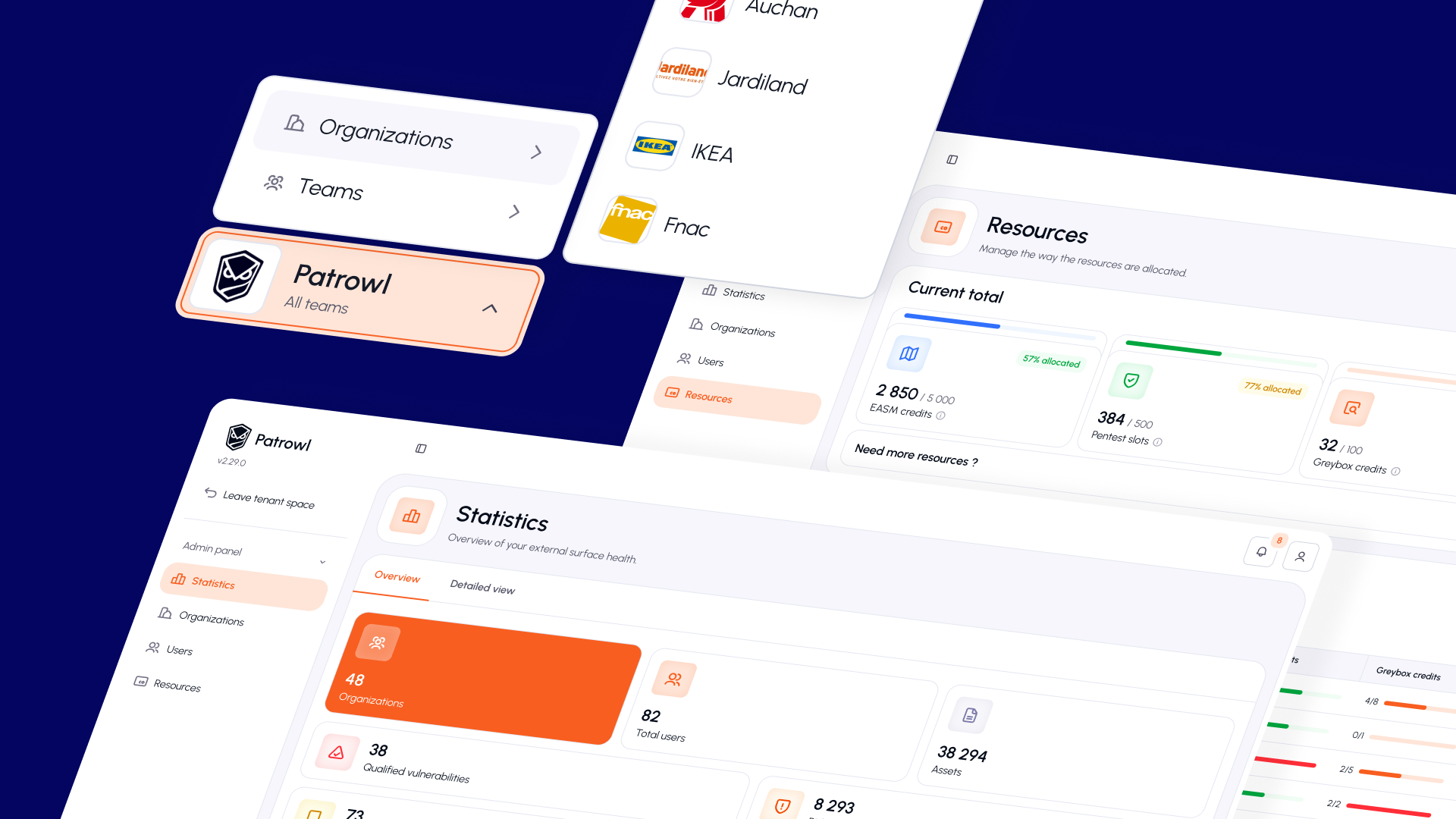
Patrowl Intel platform screenshot