New MCP server — Bring vulnerability intelligence into your AI
Back to feed

CVE-2024-26939

NVDCIRCLENISA

EUVD-2024-24201 · Published May 1, 2024

In the Linux kernel, the following vulnerability has been resolved: drm/i915/vma: Fix UAF on destroy against retire race Object debugging tools were sporadically reporting illegal attempts to free a still active i915 VMA object when parking a GT believed to be idle. [161.359441] ODEBUG: free active (active state 0) object: ffff88811643b958 object type: i915_active hint: __i915_vma_active+0x0/0x50 [i915] [161.360082] WARNING: CPU: 5 PID: 276 at lib/debugobjects.c:514 debug_print_object+0x80/0xb0 ... [161.360304] CPU: 5 PID: 276 Comm: kworker/5:2 Not tainted 6.5.0-rc1-CI_DRM_13375-g003f860e5577+ #1 [161.360314] Hardware name: Intel Corporation Rocket Lake Client Platform/RocketLake S UDIMM 6L RVP, BIOS RKLSFWI1.R00.3173.A03.2204210138 04/21/2022 [161.360322] Workqueue: i915-unordered __intel_wakeref_put_work [i915] [161.360592] RIP: 0010:debug_print_object+0x80/0xb0 ... [161.361347] debug_object_free+0xeb/0x110 [161.361362] i915_active_fini+0x14/0x130 [i915] [161.361866] release_references+0xfe/0x1f0 [i915] [161.362543] i915_vma_parked+0x1db/0x380 [i915] [161.363129] __gt_park+0x121/0x230 [i915] [161.363515] ____intel_wakeref_put_last+0x1f/0x70 [i915] That has been tracked down to be happening when another thread is deactivating the VMA inside __active_retire() helper, after the VMA's active counter has been already decremented to 0, but before deactivation of the VMA's object is reported to the object debugging tool. We could prevent from that race by serializing i915_active_fini() with __active_retire() via ref->tree_lock, but that wouldn't stop the VMA from being used, e.g. from __i915_vma_retire() called at the end of __active_retire(), after that VMA has been already freed by a concurrent i915_vma_destroy() on return from the i915_active_fini(). Then, we should rather fix the issue at the VMA level, not in i915_active. Since __i915_vma_parked() is called from __gt_park() on last put of the GT's wakeref, the issue could be addressed by holding the GT wakeref long enough for __active_retire() to complete before that wakeref is released and the GT parked. I believe the issue was introduced by commit d93939730347 ("drm/i915: Remove the vma refcount") which moved a call to i915_active_fini() from a dropped i915_vma_release(), called on last put of the removed VMA kref, to i915_vma_parked() processing path called on last put of a GT wakeref. However, its visibility to the object debugging tool was suppressed by a bug in i915_active that was fixed two weeks later with commit e92eb246feb9 ("drm/i915/active: Fix missing debug object activation"). A VMA associated with a request doesn't acquire a GT wakeref by itself. Instead, it depends on a wakeref held directly by the request's active intel_context for a GT associated with its VM, and indirectly on that intel_context's engine wakeref if the engine belongs to the same GT as the VMA's VM. Those wakerefs are released asynchronously to VMA deactivation. Fix the issue by getting a wakeref for the VMA's GT when activating it, and putting that wakeref only after the VMA is deactivated. However, exclude global GTT from that processing path, otherwise the GPU never goes idle. Since __i915_vma_retire() may be called from atomic contexts, use async variant of wakeref put. Also, to avoid circular locking dependency, take care of acquiring the wakeref before VM mutex when both are needed. v7: Add inline comments with justifications for: - using untracked variants of intel_gt_pm_get/put() (Nirmoy), - using async variant of _put(), - not getting the wakeref in case of a global GTT, - always getting the first wakeref outside vm->mutex. v6: Since __i915_vma_active/retire() callbacks are not serialized, storing a wakeref tracking handle inside struct i915_vma is not safe, and there is no other good place for that. Use untracked variants of intel_gt_pm_get/put_async(). v5: Replace "tile" with "GT" across commit description (Rodrigo), - ---truncated---

Technologies

Linux Linux Kernel

Weaknesses

CWE-416

CVSS scores

  • v3.17.0CVSS:3.1/AV:L/AC:H/PR:L/UI:N/S:U/C:H/I:H/A:H

MITRE ATT&CK

Inferred

Where this vulnerability fits in an attack

Privilege Escalation

References

Potentially impacted assets

See if this affects your attack surface

Latest trending attack

Criticalyesterday

Google Brotli decoder - Remote Code Execution via compressed requests (Exploitation Check)

This control is the second step of the Patrowl response to CVE-2026-111497 (Node2Shell). It complements the first control of 22 October 2026, which focused on the Node.js runtime, and does not replace it. Why a second control CVE-2026-111497 is an out-of-bounds write in the Google Brotli decoder, the library that decompresses Brotli ("br") data. It was first published as a Node.js vulnerability, because Node.js bundles this decoder. Later publications showed that the flaw is in the library itself. Every product that embeds an affected version of the decoder is concerned, whatever its language or vendor. A public proof of concept demonstrates code execution. Any server that decompresses request bodies sent with "Content-Encoding: br" exposes the decoder to unauthenticated attackers. Known cases include Express 5 and NestJS 11 on Node.js, Koa and Fastify setups, Bun, Envoy and Istio with request decompression enabled, and any application or reverse proxy that decodes Brotli request bodies with an affected library. The flaw also works in the other direction. A malicious server can compromise an unpatched client that decodes a Brotli response, for example Node.js fetch(), Python clients (requests, httpx, aiohttp, Scrapy) with the Brotli or brotlicffi package, or libcurl builds with Brotli support. What this control checks Patrowl sends small, valid Brotli-compressed requests to each asset and observes whether the server decodes them. The check does not depend on the technology: it detects the behaviour, whatever the stack behind it. These requests are what any legitimate client could send. They never reach the vulnerable code path and cannot affect the availability of the service. How to read the result Potentially impacted means the asset decodes Brotli request bodies: the attack surface is exposed. It does not confirm that the asset is vulnerable. The version of the Brotli decoder in use is not visible from the outside. This check covers applications that parse request bodies on their root path. A Not impacted result does not rule out exposure on other routes, nor on the client side. Checking the versions on the servers remains the only exhaustive verification. Affected and fixed versions Google Brotli 1.0.3 to 1.2.0 are affected, fixed in 1.0.10, 1.1.1 and 1.2.1. Fixed releases of the main products embedding it: Node.js 22.23.4, 24.22.1 and 26.12.1 (end-of-life lines 20.x and older and 25.x receive no fix), Bun 1.4.4, Envoy 1.37.8, 1.38.6, 1.39.3 and 1.40.0, Istio 1.29.9, 1.30.6 and 1.31.2, Python Brotli 1.2.1 and brotlicffi 1.2.1.0. Products that link against the system library depend on the Brotli package of the Linux distribution. Recommendations Update every component that embeds the Brotli decoder (only real fix). Start with the assets flagged by this control. Restart the processes after the update. Rebuild containers, single-executable applications and appliances that bundle an affected runtime or library. Reduce the exposure until the update is deployed. Reject requests with "Content-Encoding: br" at the reverse proxy, load balancer or WAF, case-insensitively and including lists such as "gzip, br". On Envoy and Istio, disable request decompression for Brotli. Review outbound calls. List the features that fetch content from servers you do not control, and patch the services that host them first.

Take 15 minutes to discover our platform with our experts

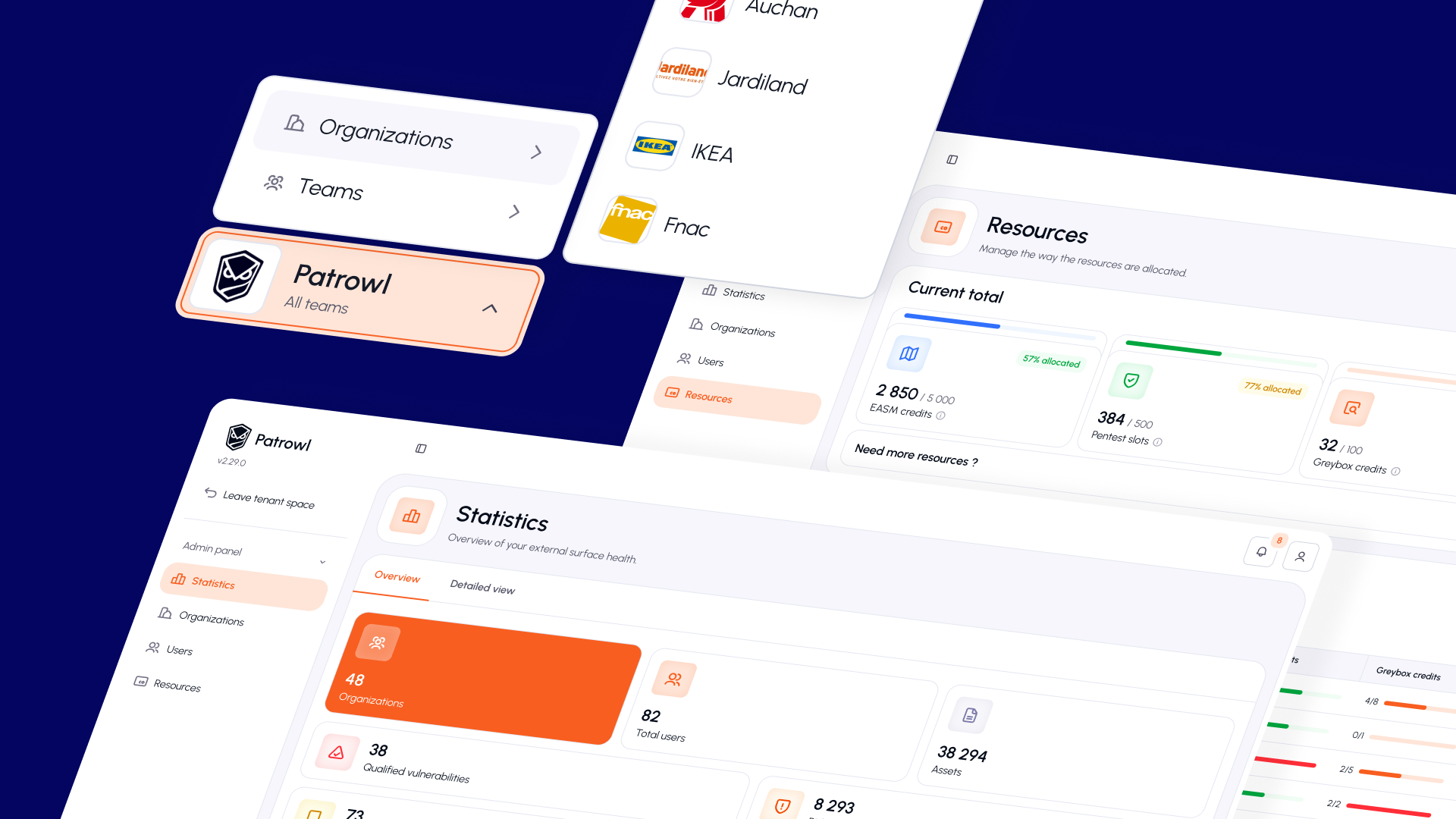
Patrowl Intel platform screenshot