New MCP server — Bring vulnerability intelligence into your AI
Back to feed

CVE-2024-45024

NVDCIRCLENISA

EUVD-2024-41504 · Published Sep 11, 2024

In the Linux kernel, the following vulnerability has been resolved: mm/hugetlb: fix hugetlb vs. core-mm PT locking We recently made GUP's common page table walking code to also walk hugetlb VMAs without most hugetlb special-casing, preparing for the future of having less hugetlb-specific page table walking code in the codebase. Turns out that we missed one page table locking detail: page table locking for hugetlb folios that are not mapped using a single PMD/PUD. Assume we have hugetlb folio that spans multiple PTEs (e.g., 64 KiB hugetlb folios on arm64 with 4 KiB base page size). GUP, as it walks the page tables, will perform a pte_offset_map_lock() to grab the PTE table lock. However, hugetlb that concurrently modifies these page tables would actually grab the mm->page_table_lock: with USE_SPLIT_PTE_PTLOCKS, the locks would differ. Something similar can happen right now with hugetlb folios that span multiple PMDs when USE_SPLIT_PMD_PTLOCKS. This issue can be reproduced [1], for example triggering: [ 3105.936100] ------------[ cut here ]------------ [ 3105.939323] WARNING: CPU: 31 PID: 2732 at mm/gup.c:142 try_grab_folio+0x11c/0x188 [ 3105.944634] Modules linked in: [...] [ 3105.974841] CPU: 31 PID: 2732 Comm: reproducer Not tainted 6.10.0-64.eln141.aarch64 #1 [ 3105.980406] Hardware name: QEMU KVM Virtual Machine, BIOS edk2-20240524-4.fc40 05/24/2024 [ 3105.986185] pstate: 60000005 (nZCv daif -PAN -UAO -TCO -DIT -SSBS BTYPE=--) [ 3105.991108] pc : try_grab_folio+0x11c/0x188 [ 3105.994013] lr : follow_page_pte+0xd8/0x430 [ 3105.996986] sp : ffff80008eafb8f0 [ 3105.999346] x29: ffff80008eafb900 x28: ffffffe8d481f380 x27: 00f80001207cff43 [ 3106.004414] x26: 0000000000000001 x25: 0000000000000000 x24: ffff80008eafba48 [ 3106.009520] x23: 0000ffff9372f000 x22: ffff7a54459e2000 x21: ffff7a546c1aa978 [ 3106.014529] x20: ffffffe8d481f3c0 x19: 0000000000610041 x18: 0000000000000001 [ 3106.019506] x17: 0000000000000001 x16: ffffffffffffffff x15: 0000000000000000 [ 3106.024494] x14: ffffb85477fdfe08 x13: 0000ffff9372ffff x12: 0000000000000000 [ 3106.029469] x11: 1fffef4a88a96be1 x10: ffff7a54454b5f0c x9 : ffffb854771b12f0 [ 3106.034324] x8 : 0008000000000000 x7 : ffff7a546c1aa980 x6 : 0008000000000080 [ 3106.038902] x5 : 00000000001207cf x4 : 0000ffff9372f000 x3 : ffffffe8d481f000 [ 3106.043420] x2 : 0000000000610041 x1 : 0000000000000001 x0 : 0000000000000000 [ 3106.047957] Call trace: [ 3106.049522] try_grab_folio+0x11c/0x188 [ 3106.051996] follow_pmd_mask.constprop.0.isra.0+0x150/0x2e0 [ 3106.055527] follow_page_mask+0x1a0/0x2b8 [ 3106.058118] __get_user_pages+0xf0/0x348 [ 3106.060647] faultin_page_range+0xb0/0x360 [ 3106.063651] do_madvise+0x340/0x598 Let's make huge_pte_lockptr() effectively use the same PT locks as any core-mm page table walker would. Add ptep_lockptr() to obtain the PTE page table lock using a pte pointer -- unfortunately we cannot convert pte_lockptr() because virt_to_page() doesn't work with kmap'ed page tables we can have with CONFIG_HIGHPTE. Handle CONFIG_PGTABLE_LEVELS correctly by checking in reverse order, such that when e.g., CONFIG_PGTABLE_LEVELS==2 with PGDIR_SIZE==P4D_SIZE==PUD_SIZE==PMD_SIZE will work as expected. Document why that works. There is one ugly case: powerpc 8xx, whereby we have an 8 MiB hugetlb folio being mapped using two PTE page tables. While hugetlb wants to take the PMD table lock, core-mm would grab the PTE table lock of one of both PTE page tables. In such corner cases, we have to make sure that both locks match, which is (fortunately!) currently guaranteed for 8xx as it does not support SMP and consequently doesn't use split PT locks. [1] https://lore.kernel.org/all/1bbfcc7f-f222-45a5-ac44-c5a1381c596d@redhat.com/

Technologies

Linux Linux

References

Potentially impacted assets

See if this affects your attack surface

Latest trending attack

Criticalyesterday

Google Brotli decoder - Remote Code Execution via compressed requests (Exploitation Check)

This control is the second step of the Patrowl response to CVE-2026-111497 (Node2Shell). It complements the first control of 22 October 2026, which focused on the Node.js runtime, and does not replace it. Why a second control CVE-2026-111497 is an out-of-bounds write in the Google Brotli decoder, the library that decompresses Brotli ("br") data. It was first published as a Node.js vulnerability, because Node.js bundles this decoder. Later publications showed that the flaw is in the library itself. Every product that embeds an affected version of the decoder is concerned, whatever its language or vendor. A public proof of concept demonstrates code execution. Any server that decompresses request bodies sent with "Content-Encoding: br" exposes the decoder to unauthenticated attackers. Known cases include Express 5 and NestJS 11 on Node.js, Koa and Fastify setups, Bun, Envoy and Istio with request decompression enabled, and any application or reverse proxy that decodes Brotli request bodies with an affected library. The flaw also works in the other direction. A malicious server can compromise an unpatched client that decodes a Brotli response, for example Node.js fetch(), Python clients (requests, httpx, aiohttp, Scrapy) with the Brotli or brotlicffi package, or libcurl builds with Brotli support. What this control checks Patrowl sends small, valid Brotli-compressed requests to each asset and observes whether the server decodes them. The check does not depend on the technology: it detects the behaviour, whatever the stack behind it. These requests are what any legitimate client could send. They never reach the vulnerable code path and cannot affect the availability of the service. How to read the result Potentially impacted means the asset decodes Brotli request bodies: the attack surface is exposed. It does not confirm that the asset is vulnerable. The version of the Brotli decoder in use is not visible from the outside. This check covers applications that parse request bodies on their root path. A Not impacted result does not rule out exposure on other routes, nor on the client side. Checking the versions on the servers remains the only exhaustive verification. Affected and fixed versions Google Brotli 1.0.3 to 1.2.0 are affected, fixed in 1.0.10, 1.1.1 and 1.2.1. Fixed releases of the main products embedding it: Node.js 22.23.4, 24.22.1 and 26.12.1 (end-of-life lines 20.x and older and 25.x receive no fix), Bun 1.4.4, Envoy 1.37.8, 1.38.6, 1.39.3 and 1.40.0, Istio 1.29.9, 1.30.6 and 1.31.2, Python Brotli 1.2.1 and brotlicffi 1.2.1.0. Products that link against the system library depend on the Brotli package of the Linux distribution. Recommendations Update every component that embeds the Brotli decoder (only real fix). Start with the assets flagged by this control. Restart the processes after the update. Rebuild containers, single-executable applications and appliances that bundle an affected runtime or library. Reduce the exposure until the update is deployed. Reject requests with "Content-Encoding: br" at the reverse proxy, load balancer or WAF, case-insensitively and including lists such as "gzip, br". On Envoy and Istio, disable request decompression for Brotli. Review outbound calls. List the features that fetch content from servers you do not control, and patch the services that host them first.

Take 15 minutes to discover our platform with our experts

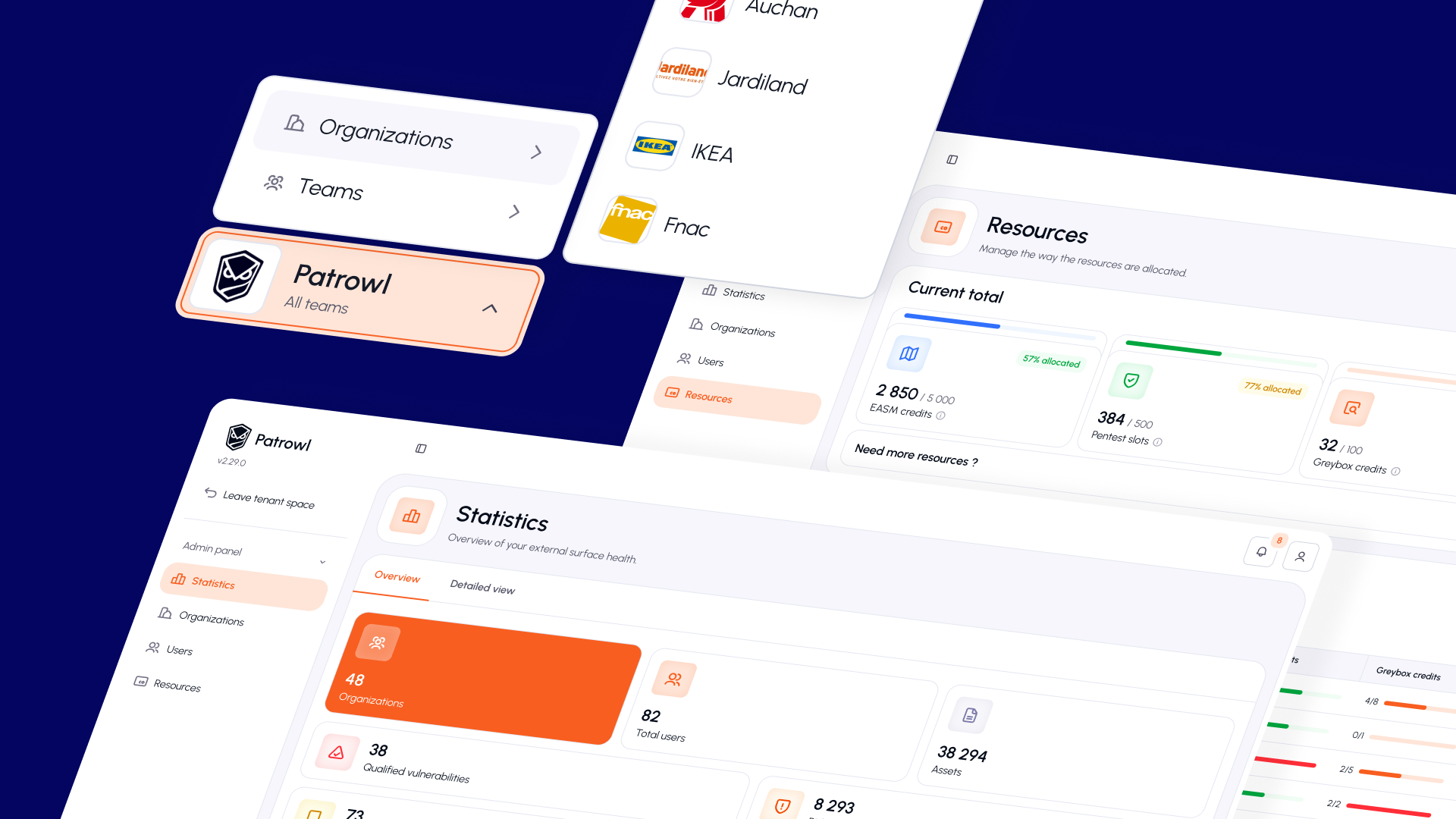
Patrowl Intel platform screenshot