New MCP server — Bring vulnerability intelligence into your AI
Back to feed

CVE-2024-53095

NVDCIRCLENISA

EUVD-2024-50511 · Published Nov 21, 2024

In the Linux kernel, the following vulnerability has been resolved: smb: client: Fix use-after-free of network namespace. Recently, we got a customer report that CIFS triggers oops while reconnecting to a server. [0] The workload runs on Kubernetes, and some pods mount CIFS servers in non-root network namespaces. The problem rarely happened, but it was always while the pod was dying. The root cause is wrong reference counting for network namespace. CIFS uses kernel sockets, which do not hold refcnt of the netns that the socket belongs to. That means CIFS must ensure the socket is always freed before its netns; otherwise, use-after-free happens. The repro steps are roughly: 1. mount CIFS in a non-root netns 2. drop packets from the netns 3. destroy the netns 4. unmount CIFS We can reproduce the issue quickly with the script [1] below and see the splat [2] if CONFIG_NET_NS_REFCNT_TRACKER is enabled. When the socket is TCP, it is hard to guarantee the netns lifetime without holding refcnt due to async timers. Let's hold netns refcnt for each socket as done for SMC in commit 9744d2bf1976 ("smc: Fix use-after-free in tcp_write_timer_handler()."). Note that we need to move put_net() from cifs_put_tcp_session() to clean_demultiplex_info(); otherwise, __sock_create() still could touch a freed netns while cifsd tries to reconnect from cifs_demultiplex_thread(). Also, maybe_get_net() cannot be put just before __sock_create() because the code is not under RCU and there is a small chance that the same address happened to be reallocated to another netns. [0]: CIFS: VFS: \\XXXXXXXXXXX has not responded in 15 seconds. Reconnecting... CIFS: Serverclose failed 4 times, giving up Unable to handle kernel paging request at virtual address 14de99e461f84a07 Mem abort info: ESR = 0x0000000096000004 EC = 0x25: DABT (current EL), IL = 32 bits SET = 0, FnV = 0 EA = 0, S1PTW = 0 FSC = 0x04: level 0 translation fault Data abort info: ISV = 0, ISS = 0x00000004 CM = 0, WnR = 0 [14de99e461f84a07] address between user and kernel address ranges Internal error: Oops: 0000000096000004 [#1] SMP Modules linked in: cls_bpf sch_ingress nls_utf8 cifs cifs_arc4 cifs_md4 dns_resolver tcp_diag inet_diag veth xt_state xt_connmark nf_conntrack_netlink xt_nat xt_statistic xt_MASQUERADE xt_mark xt_addrtype ipt_REJECT nf_reject_ipv4 nft_chain_nat nf_nat xt_conntrack nf_conntrack nf_defrag_ipv6 nf_defrag_ipv4 xt_comment nft_compat nf_tables nfnetlink overlay nls_ascii nls_cp437 sunrpc vfat fat aes_ce_blk aes_ce_cipher ghash_ce sm4_ce_cipher sm4 sm3_ce sm3 sha3_ce sha512_ce sha512_arm64 sha1_ce ena button sch_fq_codel loop fuse configfs dmi_sysfs sha2_ce sha256_arm64 dm_mirror dm_region_hash dm_log dm_mod dax efivarfs CPU: 5 PID: 2690970 Comm: cifsd Not tainted 6.1.103-109.184.amzn2023.aarch64 #1 Hardware name: Amazon EC2 r7g.4xlarge/, BIOS 1.0 11/1/2018 pstate: 00400005 (nzcv daif +PAN -UAO -TCO -DIT -SSBS BTYPE=--) pc : fib_rules_lookup+0x44/0x238 lr : __fib_lookup+0x64/0xbc sp : ffff8000265db790 x29: ffff8000265db790 x28: 0000000000000000 x27: 000000000000bd01 x26: 0000000000000000 x25: ffff000b4baf8000 x24: ffff00047b5e4580 x23: ffff8000265db7e0 x22: 0000000000000000 x21: ffff00047b5e4500 x20: ffff0010e3f694f8 x19: 14de99e461f849f7 x18: 0000000000000000 x17: 0000000000000000 x16: 0000000000000000 x15: 0000000000000000 x14: 0000000000000000 x13: 0000000000000000 x12: 3f92800abd010002 x11: 0000000000000001 x10: ffff0010e3f69420 x9 : ffff800008a6f294 x8 : 0000000000000000 x7 : 0000000000000006 x6 : 0000000000000000 x5 : 0000000000000001 x4 : ffff001924354280 x3 : ffff8000265db7e0 x2 : 0000000000000000 x1 : ffff0010e3f694f8 x0 : ffff00047b5e4500 Call trace: fib_rules_lookup+0x44/0x238 __fib_lookup+0x64/0xbc ip_route_output_key_hash_rcu+0x2c4/0x398 ip_route_output_key_hash+0x60/0x8c tcp_v4_connect+0x290/0x488 __inet_stream_connect+0x108/0x3d0 inet_stream_connect+0x50/0x78 kernel_connect+0x6c/0xac generic_ip_conne ---truncated---

Technologies

Linux Linux Kernel

Weaknesses

CWE-416

CVSS scores

  • v3.17.8CVSS:3.1/AV:L/AC:L/PR:L/UI:N/S:U/C:H/I:H/A:H

MITRE ATT&CK

Inferred

Where this vulnerability fits in an attack

Privilege Escalation

References

Potentially impacted assets

See if this affects your attack surface

Latest trending attack

Criticalyesterday

Google Brotli decoder - Remote Code Execution via compressed requests (Exploitation Check)

This control is the second step of the Patrowl response to CVE-2026-111497 (Node2Shell). It complements the first control of 22 October 2026, which focused on the Node.js runtime, and does not replace it. Why a second control CVE-2026-111497 is an out-of-bounds write in the Google Brotli decoder, the library that decompresses Brotli ("br") data. It was first published as a Node.js vulnerability, because Node.js bundles this decoder. Later publications showed that the flaw is in the library itself. Every product that embeds an affected version of the decoder is concerned, whatever its language or vendor. A public proof of concept demonstrates code execution. Any server that decompresses request bodies sent with "Content-Encoding: br" exposes the decoder to unauthenticated attackers. Known cases include Express 5 and NestJS 11 on Node.js, Koa and Fastify setups, Bun, Envoy and Istio with request decompression enabled, and any application or reverse proxy that decodes Brotli request bodies with an affected library. The flaw also works in the other direction. A malicious server can compromise an unpatched client that decodes a Brotli response, for example Node.js fetch(), Python clients (requests, httpx, aiohttp, Scrapy) with the Brotli or brotlicffi package, or libcurl builds with Brotli support. What this control checks Patrowl sends small, valid Brotli-compressed requests to each asset and observes whether the server decodes them. The check does not depend on the technology: it detects the behaviour, whatever the stack behind it. These requests are what any legitimate client could send. They never reach the vulnerable code path and cannot affect the availability of the service. How to read the result Potentially impacted means the asset decodes Brotli request bodies: the attack surface is exposed. It does not confirm that the asset is vulnerable. The version of the Brotli decoder in use is not visible from the outside. This check covers applications that parse request bodies on their root path. A Not impacted result does not rule out exposure on other routes, nor on the client side. Checking the versions on the servers remains the only exhaustive verification. Affected and fixed versions Google Brotli 1.0.3 to 1.2.0 are affected, fixed in 1.0.10, 1.1.1 and 1.2.1. Fixed releases of the main products embedding it: Node.js 22.23.4, 24.22.1 and 26.12.1 (end-of-life lines 20.x and older and 25.x receive no fix), Bun 1.4.4, Envoy 1.37.8, 1.38.6, 1.39.3 and 1.40.0, Istio 1.29.9, 1.30.6 and 1.31.2, Python Brotli 1.2.1 and brotlicffi 1.2.1.0. Products that link against the system library depend on the Brotli package of the Linux distribution. Recommendations Update every component that embeds the Brotli decoder (only real fix). Start with the assets flagged by this control. Restart the processes after the update. Rebuild containers, single-executable applications and appliances that bundle an affected runtime or library. Reduce the exposure until the update is deployed. Reject requests with "Content-Encoding: br" at the reverse proxy, load balancer or WAF, case-insensitively and including lists such as "gzip, br". On Envoy and Istio, disable request decompression for Brotli. Review outbound calls. List the features that fetch content from servers you do not control, and patch the services that host them first.

Take 15 minutes to discover our platform with our experts

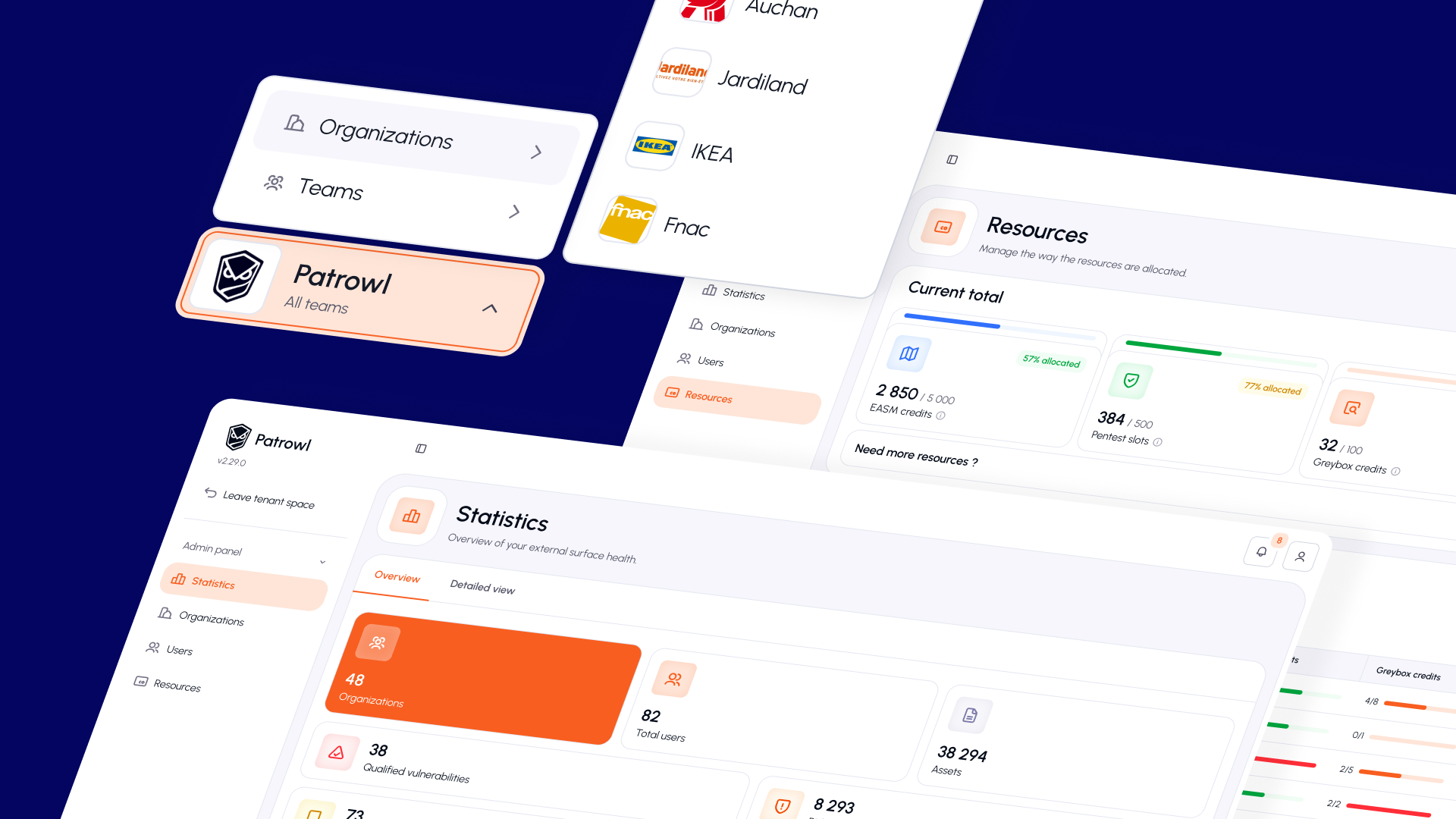
Patrowl Intel platform screenshot