New MCP server — Bring vulnerability intelligence into your AI
Back to feed

CVE-2024-57884

NVDCIRCLENISA

EUVD-2024-53787 · Published Jan 15, 2025

In the Linux kernel, the following vulnerability has been resolved: mm: vmscan: account for free pages to prevent infinite Loop in throttle_direct_reclaim() The task sometimes continues looping in throttle_direct_reclaim() because allow_direct_reclaim(pgdat) keeps returning false. #0 [ffff80002cb6f8d0] __switch_to at ffff8000080095ac #1 [ffff80002cb6f900] __schedule at ffff800008abbd1c #2 [ffff80002cb6f990] schedule at ffff800008abc50c #3 [ffff80002cb6f9b0] throttle_direct_reclaim at ffff800008273550 #4 [ffff80002cb6fa20] try_to_free_pages at ffff800008277b68 #5 [ffff80002cb6fae0] __alloc_pages_nodemask at ffff8000082c4660 #6 [ffff80002cb6fc50] alloc_pages_vma at ffff8000082e4a98 #7 [ffff80002cb6fca0] do_anonymous_page at ffff80000829f5a8 #8 [ffff80002cb6fce0] __handle_mm_fault at ffff8000082a5974 #9 [ffff80002cb6fd90] handle_mm_fault at ffff8000082a5bd4 At this point, the pgdat contains the following two zones: NODE: 4 ZONE: 0 ADDR: ffff00817fffe540 NAME: "DMA32" SIZE: 20480 MIN/LOW/HIGH: 11/28/45 VM_STAT: NR_FREE_PAGES: 359 NR_ZONE_INACTIVE_ANON: 18813 NR_ZONE_ACTIVE_ANON: 0 NR_ZONE_INACTIVE_FILE: 50 NR_ZONE_ACTIVE_FILE: 0 NR_ZONE_UNEVICTABLE: 0 NR_ZONE_WRITE_PENDING: 0 NR_MLOCK: 0 NR_BOUNCE: 0 NR_ZSPAGES: 0 NR_FREE_CMA_PAGES: 0 NODE: 4 ZONE: 1 ADDR: ffff00817fffec00 NAME: "Normal" SIZE: 8454144 PRESENT: 98304 MIN/LOW/HIGH: 68/166/264 VM_STAT: NR_FREE_PAGES: 146 NR_ZONE_INACTIVE_ANON: 94668 NR_ZONE_ACTIVE_ANON: 3 NR_ZONE_INACTIVE_FILE: 735 NR_ZONE_ACTIVE_FILE: 78 NR_ZONE_UNEVICTABLE: 0 NR_ZONE_WRITE_PENDING: 0 NR_MLOCK: 0 NR_BOUNCE: 0 NR_ZSPAGES: 0 NR_FREE_CMA_PAGES: 0 In allow_direct_reclaim(), while processing ZONE_DMA32, the sum of inactive/active file-backed pages calculated in zone_reclaimable_pages() based on the result of zone_page_state_snapshot() is zero. Additionally, since this system lacks swap, the calculation of inactive/ active anonymous pages is skipped. crash> p nr_swap_pages nr_swap_pages = $1937 = { counter = 0 } As a result, ZONE_DMA32 is deemed unreclaimable and skipped, moving on to the processing of the next zone, ZONE_NORMAL, despite ZONE_DMA32 having free pages significantly exceeding the high watermark. The problem is that the pgdat->kswapd_failures hasn't been incremented. crash> px ((struct pglist_data *) 0xffff00817fffe540)->kswapd_failures $1935 = 0x0 This is because the node deemed balanced. The node balancing logic in balance_pgdat() evaluates all zones collectively. If one or more zones (e.g., ZONE_DMA32) have enough free pages to meet their watermarks, the entire node is deemed balanced. This causes balance_pgdat() to exit early before incrementing the kswapd_failures, as it considers the overall memory state acceptable, even though some zones (like ZONE_NORMAL) remain under significant pressure. The patch ensures that zone_reclaimable_pages() includes free pages (NR_FREE_PAGES) in its calculation when no other reclaimable pages are available (e.g., file-backed or anonymous pages). This change prevents zones like ZONE_DMA32, which have sufficient free pages, from being mistakenly deemed unreclaimable. By doing so, the patch ensures proper node balancing, avoids masking pressure on other zones like ZONE_NORMAL, and prevents infinite loops in throttle_direct_reclaim() caused by allow_direct_reclaim(pgdat) repeatedly returning false. The kernel hangs due to a task stuck in throttle_direct_reclaim(), caused by a node being incorrectly deemed balanced despite pressure in certain zones, such as ZONE_NORMAL. This issue arises from zone_reclaimable_pages ---truncated---

Technologies

Linux Linux Kernel

Weaknesses

CWE-835

CVSS scores

  • v3.15.5CVSS:3.1/AV:L/AC:L/PR:L/UI:N/S:U/C:N/I:N/A:H

MITRE ATT&CK

Inferred

Where this vulnerability fits in an attack

Privilege Escalation

References

Potentially impacted assets

See if this affects your attack surface

Latest trending attack

Criticalyesterday

Google Brotli decoder - Remote Code Execution via compressed requests (Exploitation Check)

This control is the second step of the Patrowl response to CVE-2026-111497 (Node2Shell). It complements the first control of 22 October 2026, which focused on the Node.js runtime, and does not replace it. Why a second control CVE-2026-111497 is an out-of-bounds write in the Google Brotli decoder, the library that decompresses Brotli ("br") data. It was first published as a Node.js vulnerability, because Node.js bundles this decoder. Later publications showed that the flaw is in the library itself. Every product that embeds an affected version of the decoder is concerned, whatever its language or vendor. A public proof of concept demonstrates code execution. Any server that decompresses request bodies sent with "Content-Encoding: br" exposes the decoder to unauthenticated attackers. Known cases include Express 5 and NestJS 11 on Node.js, Koa and Fastify setups, Bun, Envoy and Istio with request decompression enabled, and any application or reverse proxy that decodes Brotli request bodies with an affected library. The flaw also works in the other direction. A malicious server can compromise an unpatched client that decodes a Brotli response, for example Node.js fetch(), Python clients (requests, httpx, aiohttp, Scrapy) with the Brotli or brotlicffi package, or libcurl builds with Brotli support. What this control checks Patrowl sends small, valid Brotli-compressed requests to each asset and observes whether the server decodes them. The check does not depend on the technology: it detects the behaviour, whatever the stack behind it. These requests are what any legitimate client could send. They never reach the vulnerable code path and cannot affect the availability of the service. How to read the result Potentially impacted means the asset decodes Brotli request bodies: the attack surface is exposed. It does not confirm that the asset is vulnerable. The version of the Brotli decoder in use is not visible from the outside. This check covers applications that parse request bodies on their root path. A Not impacted result does not rule out exposure on other routes, nor on the client side. Checking the versions on the servers remains the only exhaustive verification. Affected and fixed versions Google Brotli 1.0.3 to 1.2.0 are affected, fixed in 1.0.10, 1.1.1 and 1.2.1. Fixed releases of the main products embedding it: Node.js 22.23.4, 24.22.1 and 26.12.1 (end-of-life lines 20.x and older and 25.x receive no fix), Bun 1.4.4, Envoy 1.37.8, 1.38.6, 1.39.3 and 1.40.0, Istio 1.29.9, 1.30.6 and 1.31.2, Python Brotli 1.2.1 and brotlicffi 1.2.1.0. Products that link against the system library depend on the Brotli package of the Linux distribution. Recommendations Update every component that embeds the Brotli decoder (only real fix). Start with the assets flagged by this control. Restart the processes after the update. Rebuild containers, single-executable applications and appliances that bundle an affected runtime or library. Reduce the exposure until the update is deployed. Reject requests with "Content-Encoding: br" at the reverse proxy, load balancer or WAF, case-insensitively and including lists such as "gzip, br". On Envoy and Istio, disable request decompression for Brotli. Review outbound calls. List the features that fetch content from servers you do not control, and patch the services that host them first.

Take 15 minutes to discover our platform with our experts

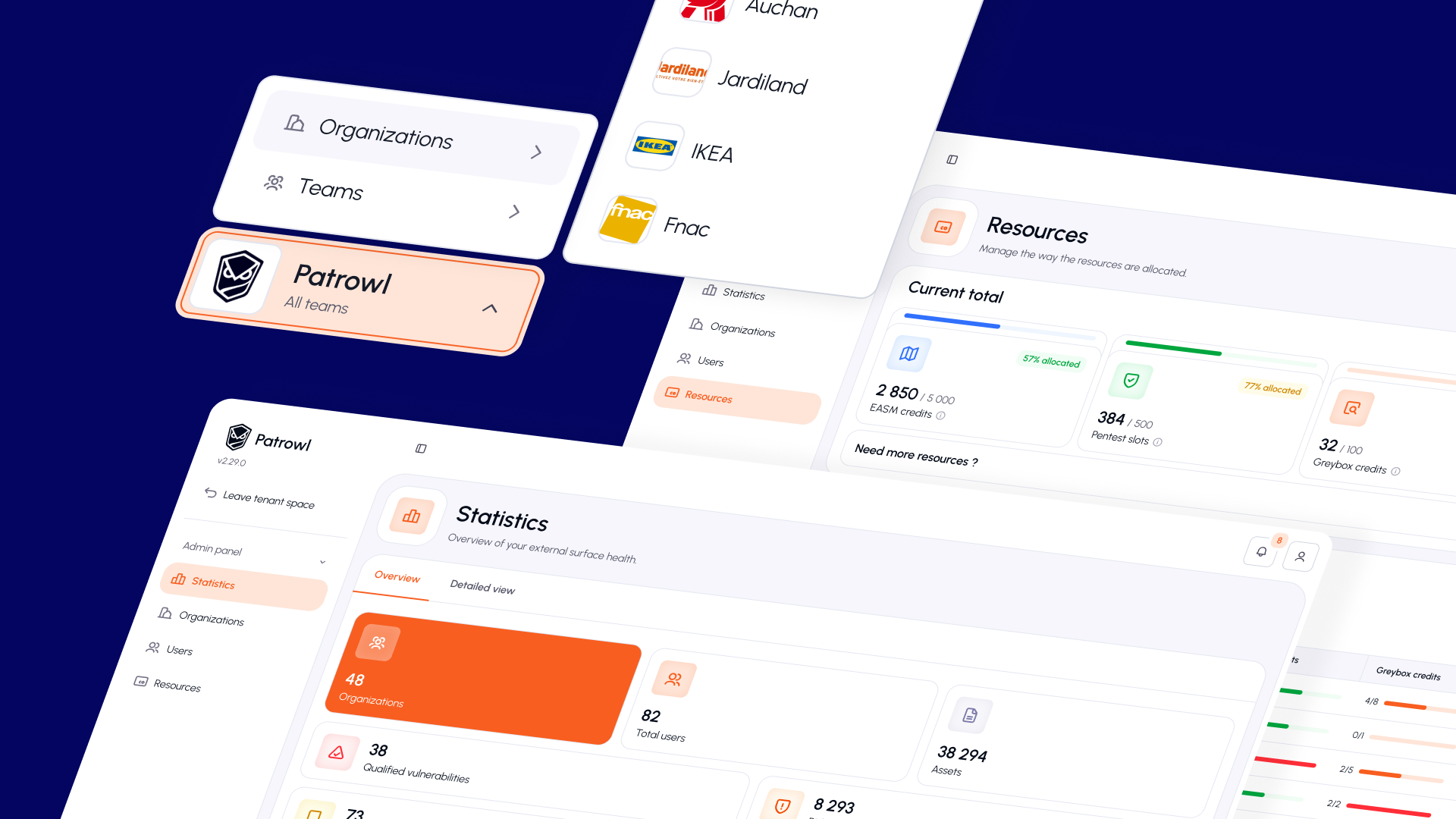
Patrowl Intel platform screenshot