New MCP server — Bring vulnerability intelligence into your AI
Back to feed

CVE-2025-21824

NVDCIRCLENISA

EUVD-2025-5972 · Published Feb 27, 2025

In the Linux kernel, the following vulnerability has been resolved: gpu: host1x: Fix a use of uninitialized mutex commit c8347f915e67 ("gpu: host1x: Fix boot regression for Tegra") caused a use of uninitialized mutex leading to below warning when CONFIG_DEBUG_MUTEXES and CONFIG_DEBUG_LOCK_ALLOC are enabled. [ 41.662843] ------------[ cut here ]------------ [ 41.663012] DEBUG_LOCKS_WARN_ON(lock->magic != lock) [ 41.663035] WARNING: CPU: 4 PID: 794 at kernel/locking/mutex.c:587 __mutex_lock+0x670/0x878 [ 41.663458] Modules linked in: rtw88_8822c(+) bluetooth(+) rtw88_pci rtw88_core mac80211 aquantia libarc4 crc_itu_t cfg80211 tegra194_cpufreq dwmac_tegra(+) arm_dsu_pmu stmmac_platform stmmac pcs_xpcs rfkill at24 host1x(+) tegra_bpmp_thermal ramoops reed_solomon fuse loop nfnetlink xfs mmc_block rpmb_core ucsi_ccg ina3221 crct10dif_ce xhci_tegra ghash_ce lm90 sha2_ce sha256_arm64 sha1_ce sdhci_tegra pwm_fan sdhci_pltfm sdhci gpio_keys rtc_tegra cqhci mmc_core phy_tegra_xusb i2c_tegra tegra186_gpc_dma i2c_tegra_bpmp spi_tegra114 dm_mirror dm_region_hash dm_log dm_mod [ 41.665078] CPU: 4 UID: 0 PID: 794 Comm: (udev-worker) Not tainted 6.11.0-29.31_1538613708.el10.aarch64+debug #1 [ 41.665838] Hardware name: NVIDIA NVIDIA Jetson AGX Orin Developer Kit/Jetson, BIOS 36.3.0-gcid-35594366 02/26/2024 [ 41.672555] pstate: 60400009 (nZCv daif +PAN -UAO -TCO -DIT -SSBS BTYPE=--) [ 41.679636] pc : __mutex_lock+0x670/0x878 [ 41.683834] lr : __mutex_lock+0x670/0x878 [ 41.688035] sp : ffff800084b77090 [ 41.691446] x29: ffff800084b77160 x28: ffffdd4bebf7b000 x27: ffffdd4be96b1000 [ 41.698799] x26: 1fffe0002308361c x25: 1ffff0001096ee18 x24: 0000000000000000 [ 41.706149] x23: 0000000000000000 x22: 0000000000000002 x21: ffffdd4be6e3c7a0 [ 41.713500] x20: ffff800084b770f0 x19: ffff00011841b1e8 x18: 0000000000000000 [ 41.720675] x17: 0000000000000000 x16: 0000000000000000 x15: 0720072007200720 [ 41.728023] x14: 0000000000000000 x13: 0000000000000001 x12: ffff6001a96eaab3 [ 41.735375] x11: 1fffe001a96eaab2 x10: ffff6001a96eaab2 x9 : ffffdd4be4838bbc [ 41.742723] x8 : 00009ffe5691554e x7 : ffff000d4b755593 x6 : 0000000000000001 [ 41.749985] x5 : ffff000d4b755590 x4 : 1fffe0001d88f001 x3 : dfff800000000000 [ 41.756988] x2 : 0000000000000000 x1 : 0000000000000000 x0 : ffff0000ec478000 [ 41.764251] Call trace: [ 41.766695] __mutex_lock+0x670/0x878 [ 41.770373] mutex_lock_nested+0x2c/0x40 [ 41.774134] host1x_intr_start+0x54/0xf8 [host1x] [ 41.778863] host1x_runtime_resume+0x150/0x228 [host1x] [ 41.783935] pm_generic_runtime_resume+0x84/0xc8 [ 41.788485] __rpm_callback+0xa0/0x478 [ 41.792422] rpm_callback+0x15c/0x1a8 [ 41.795922] rpm_resume+0x698/0xc08 [ 41.799597] __pm_runtime_resume+0xa8/0x140 [ 41.803621] host1x_probe+0x810/0xbc0 [host1x] [ 41.807909] platform_probe+0xcc/0x1a8 [ 41.811845] really_probe+0x188/0x800 [ 41.815347] __driver_probe_device+0x164/0x360 [ 41.819810] driver_probe_device+0x64/0x1a8 [ 41.823834] __driver_attach+0x180/0x490 [ 41.827773] bus_for_each_dev+0x104/0x1a0 [ 41.831797] driver_attach+0x44/0x68 [ 41.835296] bus_add_driver+0x23c/0x4e8 [ 41.839235] driver_register+0x15c/0x3a8 [ 41.843170] __platform_register_drivers+0xa4/0x208 [ 41.848159] tegra_host1x_init+0x4c/0xff8 [host1x] [ 41.853147] do_one_initcall+0xd4/0x380 [ 41.856997] do_init_module+0x1dc/0x698 [ 41.860758] load_module+0xc70/0x1300 [ 41.864435] __do_sys_init_module+0x1a8/0x1d0 [ 41.868721] __arm64_sys_init_module+0x74/0xb0 [ 41.873183] invoke_syscall.constprop.0+0xdc/0x1e8 [ 41.877997] do_el0_svc+0x154/0x1d0 [ 41.881671] el0_svc+0x54/0x140 [ 41.884820] el0t_64_sync_handler+0x120/0x130 [ 41.889285] el0t_64_sync+0x1a4/0x1a8 [ 41.892960] irq event stamp: 69737 [ 41.896370] hardirqs last enabled at (69737): [<ffffdd4be6d7768c>] _raw_spin_unlock_irqrestore+0x44/0xe8 [ 41.905739] hardirqs last disabled at (69736): ---truncated---

Technologies

Linux Linux Kernel

Weaknesses

CWE-908

CVSS scores

  • v3.15.5CVSS:3.1/AV:L/AC:L/PR:L/UI:N/S:U/C:N/I:N/A:H

MITRE ATT&CK

Inferred

Where this vulnerability fits in an attack

Privilege Escalation

References

Potentially impacted assets

See if this affects your attack surface

Latest trending attack

Criticalyesterday

Google Brotli decoder - Remote Code Execution via compressed requests (Exploitation Check)

This control is the second step of the Patrowl response to CVE-2026-111497 (Node2Shell). It complements the first control of 22 October 2026, which focused on the Node.js runtime, and does not replace it. Why a second control CVE-2026-111497 is an out-of-bounds write in the Google Brotli decoder, the library that decompresses Brotli ("br") data. It was first published as a Node.js vulnerability, because Node.js bundles this decoder. Later publications showed that the flaw is in the library itself. Every product that embeds an affected version of the decoder is concerned, whatever its language or vendor. A public proof of concept demonstrates code execution. Any server that decompresses request bodies sent with "Content-Encoding: br" exposes the decoder to unauthenticated attackers. Known cases include Express 5 and NestJS 11 on Node.js, Koa and Fastify setups, Bun, Envoy and Istio with request decompression enabled, and any application or reverse proxy that decodes Brotli request bodies with an affected library. The flaw also works in the other direction. A malicious server can compromise an unpatched client that decodes a Brotli response, for example Node.js fetch(), Python clients (requests, httpx, aiohttp, Scrapy) with the Brotli or brotlicffi package, or libcurl builds with Brotli support. What this control checks Patrowl sends small, valid Brotli-compressed requests to each asset and observes whether the server decodes them. The check does not depend on the technology: it detects the behaviour, whatever the stack behind it. These requests are what any legitimate client could send. They never reach the vulnerable code path and cannot affect the availability of the service. How to read the result Potentially impacted means the asset decodes Brotli request bodies: the attack surface is exposed. It does not confirm that the asset is vulnerable. The version of the Brotli decoder in use is not visible from the outside. This check covers applications that parse request bodies on their root path. A Not impacted result does not rule out exposure on other routes, nor on the client side. Checking the versions on the servers remains the only exhaustive verification. Affected and fixed versions Google Brotli 1.0.3 to 1.2.0 are affected, fixed in 1.0.10, 1.1.1 and 1.2.1. Fixed releases of the main products embedding it: Node.js 22.23.4, 24.22.1 and 26.12.1 (end-of-life lines 20.x and older and 25.x receive no fix), Bun 1.4.4, Envoy 1.37.8, 1.38.6, 1.39.3 and 1.40.0, Istio 1.29.9, 1.30.6 and 1.31.2, Python Brotli 1.2.1 and brotlicffi 1.2.1.0. Products that link against the system library depend on the Brotli package of the Linux distribution. Recommendations Update every component that embeds the Brotli decoder (only real fix). Start with the assets flagged by this control. Restart the processes after the update. Rebuild containers, single-executable applications and appliances that bundle an affected runtime or library. Reduce the exposure until the update is deployed. Reject requests with "Content-Encoding: br" at the reverse proxy, load balancer or WAF, case-insensitively and including lists such as "gzip, br". On Envoy and Istio, disable request decompression for Brotli. Review outbound calls. List the features that fetch content from servers you do not control, and patch the services that host them first.

Take 15 minutes to discover our platform with our experts

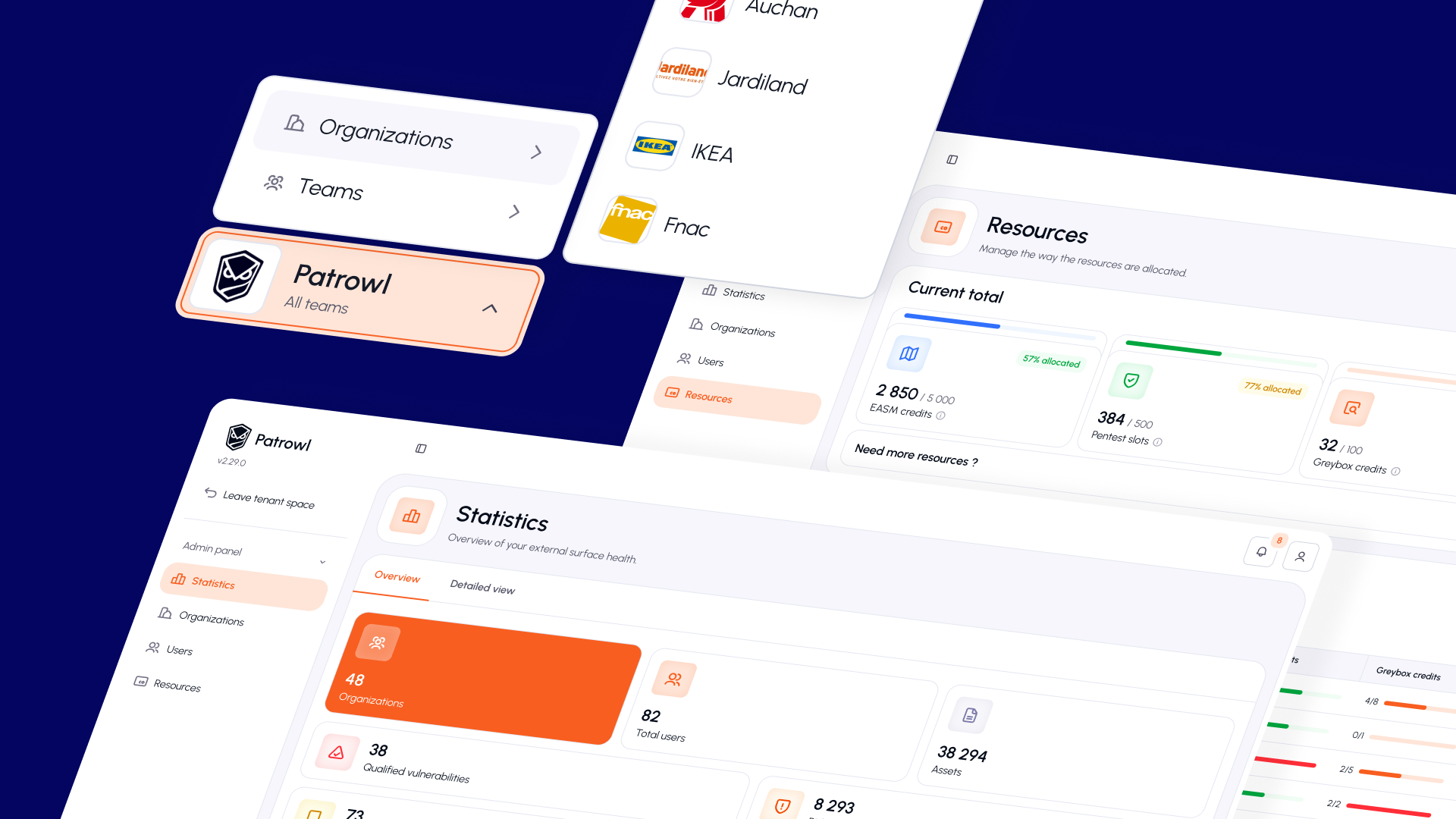
Patrowl Intel platform screenshot