New MCP server — Bring vulnerability intelligence into your AI
Back to feed

CVE-2025-39989

NVDCIRCLENISA

EUVD-2025-11814 · Published Apr 18, 2025

In the Linux kernel, the following vulnerability has been resolved: x86/mce: use is_copy_from_user() to determine copy-from-user context Patch series "mm/hwpoison: Fix regressions in memory failure handling", v4. ## 1. What am I trying to do: This patchset resolves two critical regressions related to memory failure handling that have appeared in the upstream kernel since version 5.17, as compared to 5.10 LTS. - copyin case: poison found in user page while kernel copying from user space - instr case: poison found while instruction fetching in user space ## 2. What is the expected outcome and why - For copyin case: Kernel can recover from poison found where kernel is doing get_user() or copy_from_user() if those places get an error return and the kernel return -EFAULT to the process instead of crashing. More specifily, MCE handler checks the fixup handler type to decide whether an in kernel #MC can be recovered. When EX_TYPE_UACCESS is found, the PC jumps to recovery code specified in _ASM_EXTABLE_FAULT() and return a -EFAULT to user space. - For instr case: If a poison found while instruction fetching in user space, full recovery is possible. User process takes #PF, Linux allocates a new page and fills by reading from storage. ## 3. What actually happens and why - For copyin case: kernel panic since v5.17 Commit 4c132d1d844a ("x86/futex: Remove .fixup usage") introduced a new extable fixup type, EX_TYPE_EFAULT_REG, and later patches updated the extable fixup type for copy-from-user operations, changing it from EX_TYPE_UACCESS to EX_TYPE_EFAULT_REG. It breaks previous EX_TYPE_UACCESS handling when posion found in get_user() or copy_from_user(). - For instr case: user process is killed by a SIGBUS signal due to #CMCI and #MCE race When an uncorrected memory error is consumed there is a race between the CMCI from the memory controller reporting an uncorrected error with a UCNA signature, and the core reporting and SRAR signature machine check when the data is about to be consumed. ### Background: why *UN*corrected errors tied to *C*MCI in Intel platform [1] Prior to Icelake memory controllers reported patrol scrub events that detected a previously unseen uncorrected error in memory by signaling a broadcast machine check with an SRAO (Software Recoverable Action Optional) signature in the machine check bank. This was overkill because it's not an urgent problem that no core is on the verge of consuming that bad data. It's also found that multi SRAO UCE may cause nested MCE interrupts and finally become an IERR. Hence, Intel downgrades the machine check bank signature of patrol scrub from SRAO to UCNA (Uncorrected, No Action required), and signal changed to #CMCI. Just to add to the confusion, Linux does take an action (in uc_decode_notifier()) to try to offline the page despite the UC*NA* signature name. ### Background: why #CMCI and #MCE race when poison is consuming in Intel platform [1] Having decided that CMCI/UCNA is the best action for patrol scrub errors, the memory controller uses it for reads too. But the memory controller is executing asynchronously from the core, and can't tell the difference between a "real" read and a speculative read. So it will do CMCI/UCNA if an error is found in any read. Thus: 1) Core is clever and thinks address A is needed soon, issues a speculative read. 2) Core finds it is going to use address A soon after sending the read request 3) The CMCI from the memory controller is in a race with MCE from the core that will soon try to retire the load from address A. Quite often (because speculation has got better) the CMCI from the memory controller is delivered before the core is committed to the instruction reading address A, so the interrupt is taken, and Linux offlines the page (marking it as poison). ## Why user process is killed for instr case Commit 046545a661af ("mm/hwpoison: fix error page recovered but reported "not ---truncated---

Technologies

Linux Linux Kernel

Weaknesses

CWE-401

CVSS scores

  • v3.15.5CVSS:3.1/AV:L/AC:L/PR:L/UI:N/S:U/C:N/I:N/A:H

MITRE ATT&CK

Inferred

Where this vulnerability fits in an attack

Privilege Escalation

References

Potentially impacted assets

See if this affects your attack surface

Latest trending attack

Criticalyesterday

Google Brotli decoder - Remote Code Execution via compressed requests (Exploitation Check)

This control is the second step of the Patrowl response to CVE-2026-111497 (Node2Shell). It complements the first control of 22 October 2026, which focused on the Node.js runtime, and does not replace it. Why a second control CVE-2026-111497 is an out-of-bounds write in the Google Brotli decoder, the library that decompresses Brotli ("br") data. It was first published as a Node.js vulnerability, because Node.js bundles this decoder. Later publications showed that the flaw is in the library itself. Every product that embeds an affected version of the decoder is concerned, whatever its language or vendor. A public proof of concept demonstrates code execution. Any server that decompresses request bodies sent with "Content-Encoding: br" exposes the decoder to unauthenticated attackers. Known cases include Express 5 and NestJS 11 on Node.js, Koa and Fastify setups, Bun, Envoy and Istio with request decompression enabled, and any application or reverse proxy that decodes Brotli request bodies with an affected library. The flaw also works in the other direction. A malicious server can compromise an unpatched client that decodes a Brotli response, for example Node.js fetch(), Python clients (requests, httpx, aiohttp, Scrapy) with the Brotli or brotlicffi package, or libcurl builds with Brotli support. What this control checks Patrowl sends small, valid Brotli-compressed requests to each asset and observes whether the server decodes them. The check does not depend on the technology: it detects the behaviour, whatever the stack behind it. These requests are what any legitimate client could send. They never reach the vulnerable code path and cannot affect the availability of the service. How to read the result Potentially impacted means the asset decodes Brotli request bodies: the attack surface is exposed. It does not confirm that the asset is vulnerable. The version of the Brotli decoder in use is not visible from the outside. This check covers applications that parse request bodies on their root path. A Not impacted result does not rule out exposure on other routes, nor on the client side. Checking the versions on the servers remains the only exhaustive verification. Two situations are possible. When the decoding is done by your own application or reverse proxy, identify the component and update it. If an update is not possible right away, reject requests with "Content-Encoding: br" at the reverse proxy or WAF. When the asset is hosted on a managed platform or behind a CDN (for example Platform.sh, Upsun or Fastly), the decoding may be done by the provider's edge router, in front of your application. You cannot patch it yourself, but this router handles all the traffic of your site. Ask your provider to confirm that its edge components are patched against CVE-2026-111497. Assets hosted on a managed platform or behind a CDN carry the tag "paas: platform.sh" or "cdn: fastly" in the asset view: for these assets, the Brotli decoding is done by the provider's edge router, in front of your application, and only the provider can patch it. Affected and fixed versions Google Brotli 1.0.3 to 1.2.0 are affected, fixed in 1.0.10, 1.1.1 and 1.2.1. Fixed releases of the main products embedding it: Node.js 22.23.4, 24.22.1 and 26.12.1 (end-of-life lines 20.x and older and 25.x receive no fix), Bun 1.4.4, Envoy 1.37.8, 1.38.6, 1.39.3 and 1.40.0, Istio 1.29.9, 1.30.6 and 1.31.2, Python Brotli 1.2.1 and brotlicffi 1.2.1.0. Products that link against the system library depend on the Brotli package of the Linux distribution. Recommendations Update every component that embeds the Brotli decoder (only real fix). Start with the assets flagged by this control. Restart the processes after the update. Rebuild containers, single-executable applications and appliances that bundle an affected runtime or library. Reduce the exposure until the update is deployed. Reject requests with "Content-Encoding: br" at the reverse proxy, load balancer or WAF, case-insensitively and including lists such as "gzip, br". On Envoy and Istio, disable request decompression for Brotli. Contact your edge provider about the status of the pathing (Fastly / Plateform.sh) Review outbound calls. List the features that fetch content from servers you do not control, and patch the services that host them first.

Take 15 minutes to discover our platform with our experts

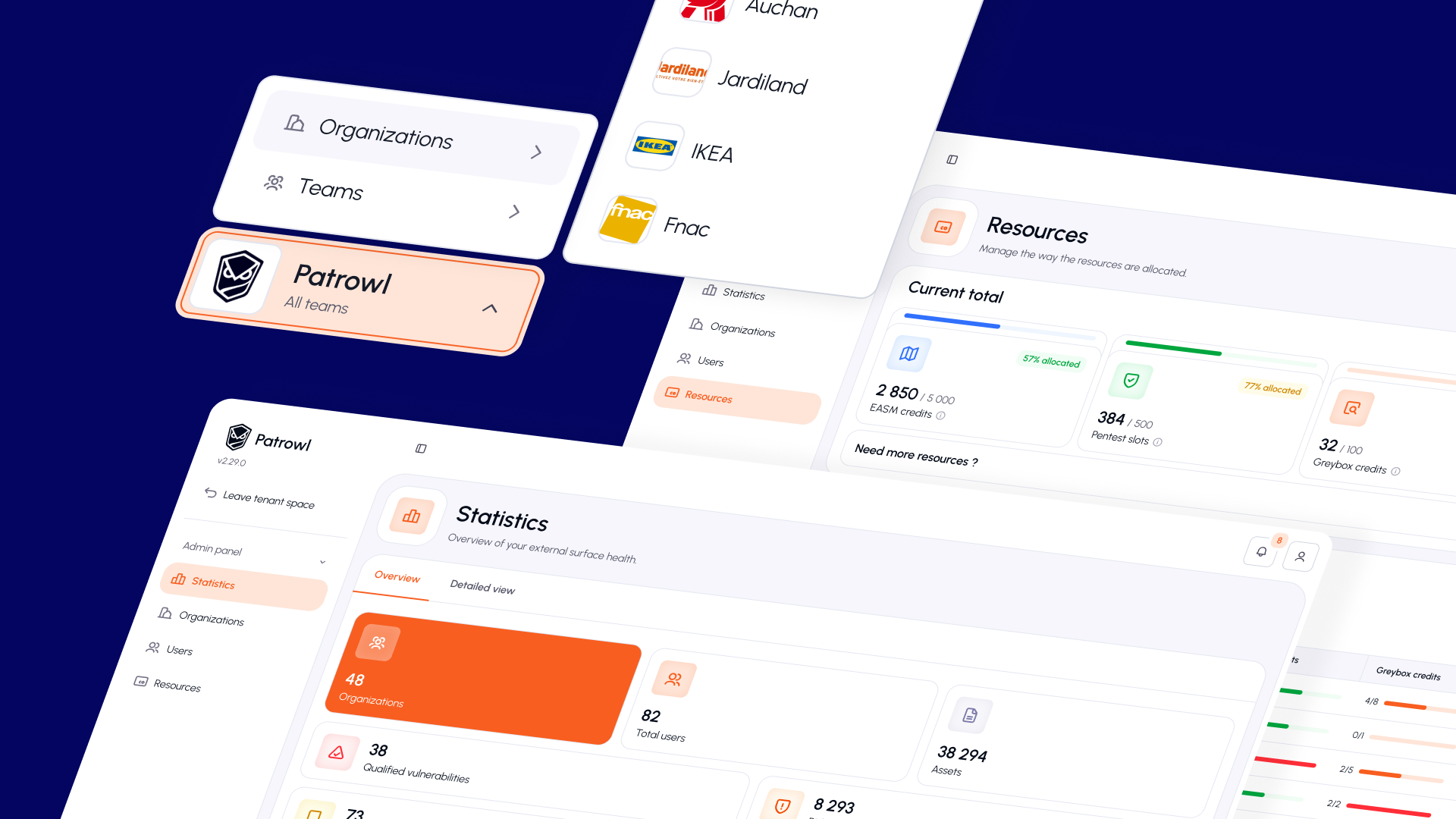
PatrowlIntel platform screenshot