New API has Potential XSS in its MarkdownRenderer component
Summary
A potential unsafe operation occurs in component MarkdownRenderer.jsx, allowing for Cross-Site Scripting(XSS) when the model outputs items containing <script> tag.
Details
Line 212-231 of MarkdownRenderer.jsx is unsafe, it use dangerouslySetInnerHTML to preview html the model generates. This can trigger malcious scripts.
PoC
A simple way to exploit that is to ask the model in the playground, with prompt: "请帮我写个脚本,跳转到google", and then the browser will navigate to the google.com without user interference.
Impact
Potential malcious activity to the user using playground, if the model api is altered to output unintended codes.
Also, users may not be easily rid the exploit, since the record of the chat containing XSS script is stored, once opening the page later, the script will be re-triggered.
Potential Workaround
The preview may be placed in an iframe sandbox, dangerous html strings should be purified before rendering.
The reply generated for test is as below:
这是一个为您编写的单页 HTML 文件。它使用了两种方式来实现跳转,以确保在任何情况下都能工作:
- JavaScript (
window.location.replace):这是最常用且高效的方法,它会立即跳转,并且不会保留当前页面在浏览器历史记录中(这样用户按“后退”键不会回到这个跳转页)。
- HTML Meta Refresh:作为后备方案。如果用户的浏览器禁用了 JavaScript,这个标签会在 1 秒后将用户带往 Google。
- 手动链接:页面中显示了一个备用链接,以防自动跳转被拦截或失效。
您可以直接保存以下代码为 .html 文件并在浏览器中打开。
<!DOCTYPE html>
<html lang="zh-CN">
<head>
    <meta charset="UTF-8">
    <meta name="viewport" content="width=device-width, initial-scale=1.0">
    <title>正在跳转至 Google...</title>

    <!-- 方法1:HTML Meta Refresh (如果JS被禁用,1秒后自动跳转) -->
    <meta http-equiv="refresh" content="1;url=https://www.google.com">

    <style>
        /* 基础重置与布局 */
        body, html {
            height: 100%;
            margin: 0;
            font-family: -apple-system, BlinkMacSystemFont, "Segoe UI", Roboto, "Helvetica Neue", Arial, sans-serif;
            background-color: #f8f9fa;
            color: #202124;
            display: flex;
            justify-content: center;
            align-items: center;
        }

        /* 卡片容器样式 */
        .redirect-card {
            background: white;
            padding: 2rem 3rem;
            border-radius: 12px;
            box-shadow: 0 4px 12px rgba(0, 0, 0, 0.1);
            text-align: center;
            max-width: 400px;
            width: 90%;
        }

        /* 加载动画圆圈 */
        .spinner {
            border: 4px solid #f3f3f3;
            border-top: 4px solid #4285f4; /* Google Blue */
            border-radius: 50%;
            width: 40px;
            height: 40px;
            animation: spin 1s linear infinite;
            margin: 0 auto 1.5rem auto;
        }

        /* 文本排版 */
        h1 {
            font-size: 1.25rem;
            margin-bottom: 0.5rem;
            font-weight: 500;
        }

        p {
            font-size: 0.95rem;
            color: #5f6368;
            margin-bottom: 1.5rem;
            line-height: 1.5;
        }

        /* 手动链接样式 */
        .manual-link {
            display: inline-block;
            color: #1a73e8; /* Google Link Blue */
            text-decoration: none;
            font-weight: 500;
            padding: 0.5rem 1rem;
            border: 1px solid #dadce0;
            border-radius: 4px;
            transition: background-color 0.2s;
        }

        .manual-link:hover {
            background-color: #f1f3f4;
            text-decoration: underline;
        }

        /* 动画定义 */
        @keyframes spin {
            0% { transform: rotate(0deg); }
            100% { transform: rotate(360deg); }
        }
    </style>
</head>
<body>

    <main class="redirect-card">
        <!-- 视觉反馈:加载动画 -->
        <div class="spinner"></div>

        <!-- 提示信息 -->
        <h1>正在为您跳转</h1>
        <p>我们正在将您引导至 Google。<br>如果页面没有自动刷新,请点击下方的按钮。</p>

        <!-- 手动跳转链接 -->
        <a href="https://www.google.com" class="manual-link">立即前往 Google</a>
    </main>

    <script>
        // 方法2:JavaScript 跳转 (推荐)
        // 使用 replace() 而不是 href,这样用户点击“后退”时不会死循环回到这个跳转页
        (function() {
            // 目标地址
            var targetUrl = "https://www.google.com";

            // 执行跳转
            window.location.replace(targetUrl);

            // 控制台日志(用于调试)
            console.log("Redirecting to: " + targetUrl);
        })();
    </script>

</body>
</html>
Acknowledgments
QuantumNous would like to thank TechnologyStar for the early notification of this potential vulnerability via AI-assisted tools, and small-lovely-cat for providing additional context and an initial patch. The final fix was developed and verified by the maintainers to ensure full compatibility with the project's architecture.
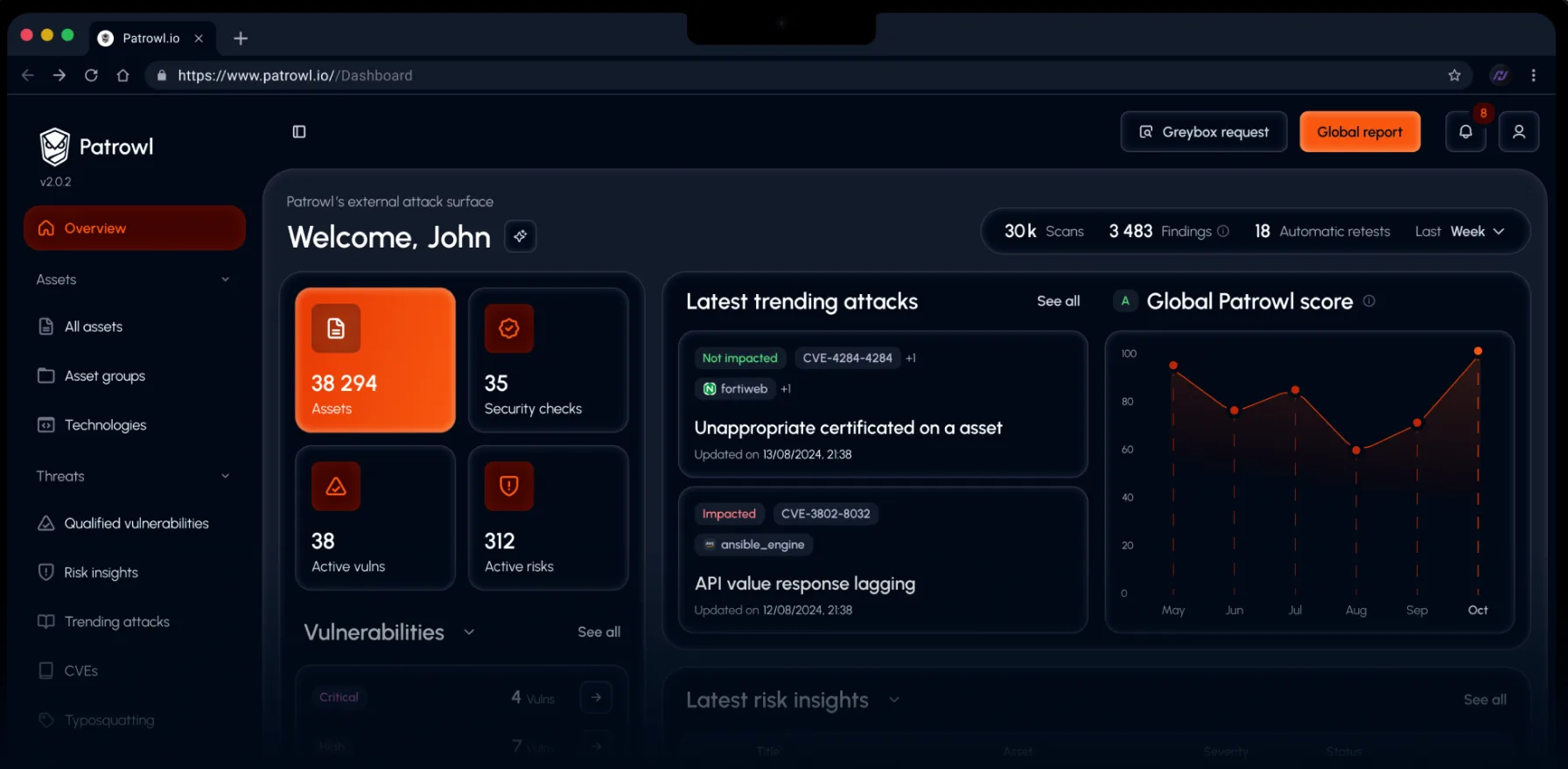
Latest trending attack
Criticalyesterday
Google Brotli decoder - Remote Code Execution via compressed requests (Exploitation Check)
This control is the second step of the Patrowl response to CVE-2026-111497 (Node2Shell). It complements the first control of 22 October 2026, which focused on the Node.js runtime, and does not replace it.
Why a second control
CVE-2026-111497 is an out-of-bounds write in the Google Brotli decoder, the library that decompresses Brotli ("br") data. It was first published as a Node.js vulnerability, because Node.js bundles this decoder. Later publications showed that the flaw is in the library itself. Every product that embeds an affected version of the decoder is concerned, whatever its language or vendor. A public proof of concept demonstrates code execution.
Any server that decompresses request bodies sent with "Content-Encoding: br" exposes the decoder to unauthenticated attackers. Known cases include Express 5 and NestJS 11 on Node.js, Koa and Fastify setups, Bun, Envoy and Istio with request decompression enabled, and any application or reverse proxy that decodes Brotli request bodies with an affected library.
The flaw also works in the other direction. A malicious server can compromise an unpatched client that decodes a Brotli response, for example Node.js fetch(), Python clients (requests, httpx, aiohttp, Scrapy) with the Brotli or brotlicffi package, or libcurl builds with Brotli support.
What this control checks
Patrowl sends small, valid Brotli-compressed requests to each asset and observes whether the server decodes them. The check does not depend on the technology: it detects the behaviour, whatever the stack behind it. These requests are what any legitimate client could send. They never reach the vulnerable code path and cannot affect the availability of the service.
How to read the result
Potentially impacted means the asset decodes Brotli request bodies: the attack surface is exposed. It does not confirm that the asset is vulnerable. The version of the Brotli decoder in use is not visible from the outside.
This check covers applications that parse request bodies on their root path. A Not impacted result does not rule out exposure on other routes, nor on the client side. Checking the versions on the servers remains the only exhaustive verification.
Affected and fixed versions
Google Brotli 1.0.3 to 1.2.0 are affected, fixed in 1.0.10, 1.1.1 and 1.2.1. Fixed releases of the main products embedding it: Node.js 22.23.4, 24.22.1 and 26.12.1 (end-of-life lines 20.x and older and 25.x receive no fix), Bun 1.4.4, Envoy 1.37.8, 1.38.6, 1.39.3 and 1.40.0, Istio 1.29.9, 1.30.6 and 1.31.2, Python Brotli 1.2.1 and brotlicffi 1.2.1.0. Products that link against the system library depend on the Brotli package of the Linux distribution.
Recommendations
Update every component that embeds the Brotli decoder (only real fix). Start with the assets flagged by this control. Restart the processes after the update. Rebuild containers, single-executable applications and appliances that bundle an affected runtime or library.
Reduce the exposure until the update is deployed. Reject requests with "Content-Encoding: br" at the reverse proxy, load balancer or WAF, case-insensitively and including lists such as "gzip, br". On Envoy and Istio, disable request decompression for Brotli.
Review outbound calls. List the features that fetch content from servers you do not control, and patch the services that host them first.