New MCP server — Bring vulnerability intelligence into your AI
Back to feed

CVE-2026-43194

NVDCIRCLENISA

EUVD-2026-27755 · Published May 6, 2026

In the Linux kernel, the following vulnerability has been resolved: net: consume xmit errors of GSO frames udpgro_frglist.sh and udpgro_bench.sh are the flakiest tests currently in NIPA. They fail in the same exact way, TCP GRO test stalls occasionally and the test gets killed after 10min. These tests use veth to simulate GRO. They attach a trivial ("return XDP_PASS;") XDP program to the veth to force TSO off and NAPI on. Digging into the failure mode we can see that the connection is completely stuck after a burst of drops. The sender's snd_nxt is at sequence number N [1], but the receiver claims to have received (rcv_nxt) up to N + 3 * MSS [2]. Last piece of the puzzle is that senders rtx queue is not empty (let's say the block in the rtx queue is at sequence number N - 4 * MSS [3]). In this state, sender sends a retransmission from the rtx queue with a single segment, and sequence numbers N-4*MSS:N-3*MSS [3]. Receiver sees it and responds with an ACK all the way up to N + 3 * MSS [2]. But sender will reject this ack as TCP_ACK_UNSENT_DATA because it has no recollection of ever sending data that far out [1]. And we are stuck. The root cause is the mess of the xmit return codes. veth returns an error when it can't xmit a frame. We end up with a loss event like this: ------------------------------------------------- | GSO super frame 1 | GSO super frame 2 | |-----------------------------------------------| | seg | seg | seg | seg | seg | seg | seg | seg | | 1 | 2 | 3 | 4 | 5 | 6 | 7 | 8 | ------------------------------------------------- x ok ok <ok>| ok ok ok <x> \\ snd_nxt "x" means packet lost by veth, and "ok" means it went thru. Since veth has TSO disabled in this test it sees individual segments. Segment 1 is on the retransmit queue and will be resent. So why did the sender not advance snd_nxt even tho it clearly did send up to seg 8? tcp_write_xmit() interprets the return code from the core to mean that data has not been sent at all. Since TCP deals with GSO super frames, not individual segment the crux of the problem is that loss of a single segment can be interpreted as loss of all. TCP only sees the last return code for the last segment of the GSO frame (in <> brackets in the diagram above). Of course for the problem to occur we need a setup or a device without a Qdisc. Otherwise Qdisc layer disconnects the protocol layer from the device errors completely. We have multiple ways to fix this. 1) make veth not return an error when it lost a packet. While this is what I think we did in the past, the issue keeps reappearing and it's annoying to debug. The game of whack a mole is not great. 2) fix the damn return codes We only talk about NETDEV_TX_OK and NETDEV_TX_BUSY in the documentation, so maybe we should make the return code from ndo_start_xmit() a boolean. I like that the most, but perhaps some ancient, not-really-networking protocol would suffer. 3) make TCP ignore the errors It is not entirely clear to me what benefit TCP gets from interpreting the result of ip_queue_xmit()? Specifically once the connection is established and we're pushing data - packet loss is just packet loss? 4) this fix Ignore the rc in the Qdisc-less+GSO case, since it's unreliable. We already always return OK in the TCQ_F_CAN_BYPASS case. In the Qdisc-less case let's be a bit more conservative and only mask the GSO errors. This path is taken by non-IP-"networks" like CAN, MCTP etc, so we could regress some ancient thing. This is the simplest, but also maybe the hackiest fix? Similar fix has been proposed by Eric in the past but never committed because original reporter was working with an OOT driver and wasn't providing feedback (see Link).

Technologies

Linux Linux Kernel

Weaknesses

CWE-754

CVSS scores

  • v3.17.5CVSS:3.1/AV:N/AC:L/PR:N/UI:N/S:U/C:N/I:N/A:H

MITRE ATT&CK

Inferred

Where this vulnerability fits in an attack

Initial Access

References

Potentially impacted assets

See if this affects your attack surface

Latest trending attack

Criticalyesterday

Google Brotli decoder - Remote Code Execution via compressed requests (Exploitation Check)

This control is the second step of the Patrowl response to CVE-2026-111497 (Node2Shell). It complements the first control of 22 October 2026, which focused on the Node.js runtime, and does not replace it. Why a second control CVE-2026-111497 is an out-of-bounds write in the Google Brotli decoder, the library that decompresses Brotli ("br") data. It was first published as a Node.js vulnerability, because Node.js bundles this decoder. Later publications showed that the flaw is in the library itself. Every product that embeds an affected version of the decoder is concerned, whatever its language or vendor. A public proof of concept demonstrates code execution. Any server that decompresses request bodies sent with "Content-Encoding: br" exposes the decoder to unauthenticated attackers. Known cases include Express 5 and NestJS 11 on Node.js, Koa and Fastify setups, Bun, Envoy and Istio with request decompression enabled, and any application or reverse proxy that decodes Brotli request bodies with an affected library. The flaw also works in the other direction. A malicious server can compromise an unpatched client that decodes a Brotli response, for example Node.js fetch(), Python clients (requests, httpx, aiohttp, Scrapy) with the Brotli or brotlicffi package, or libcurl builds with Brotli support. What this control checks Patrowl sends small, valid Brotli-compressed requests to each asset and observes whether the server decodes them. The check does not depend on the technology: it detects the behaviour, whatever the stack behind it. These requests are what any legitimate client could send. They never reach the vulnerable code path and cannot affect the availability of the service. How to read the result Potentially impacted means the asset decodes Brotli request bodies: the attack surface is exposed. It does not confirm that the asset is vulnerable. The version of the Brotli decoder in use is not visible from the outside. This check covers applications that parse request bodies on their root path. A Not impacted result does not rule out exposure on other routes, nor on the client side. Checking the versions on the servers remains the only exhaustive verification. Affected and fixed versions Google Brotli 1.0.3 to 1.2.0 are affected, fixed in 1.0.10, 1.1.1 and 1.2.1. Fixed releases of the main products embedding it: Node.js 22.23.4, 24.22.1 and 26.12.1 (end-of-life lines 20.x and older and 25.x receive no fix), Bun 1.4.4, Envoy 1.37.8, 1.38.6, 1.39.3 and 1.40.0, Istio 1.29.9, 1.30.6 and 1.31.2, Python Brotli 1.2.1 and brotlicffi 1.2.1.0. Products that link against the system library depend on the Brotli package of the Linux distribution. Recommendations Update every component that embeds the Brotli decoder (only real fix). Start with the assets flagged by this control. Restart the processes after the update. Rebuild containers, single-executable applications and appliances that bundle an affected runtime or library. Reduce the exposure until the update is deployed. Reject requests with "Content-Encoding: br" at the reverse proxy, load balancer or WAF, case-insensitively and including lists such as "gzip, br". On Envoy and Istio, disable request decompression for Brotli. Review outbound calls. List the features that fetch content from servers you do not control, and patch the services that host them first.

Take 15 minutes to discover our platform with our experts

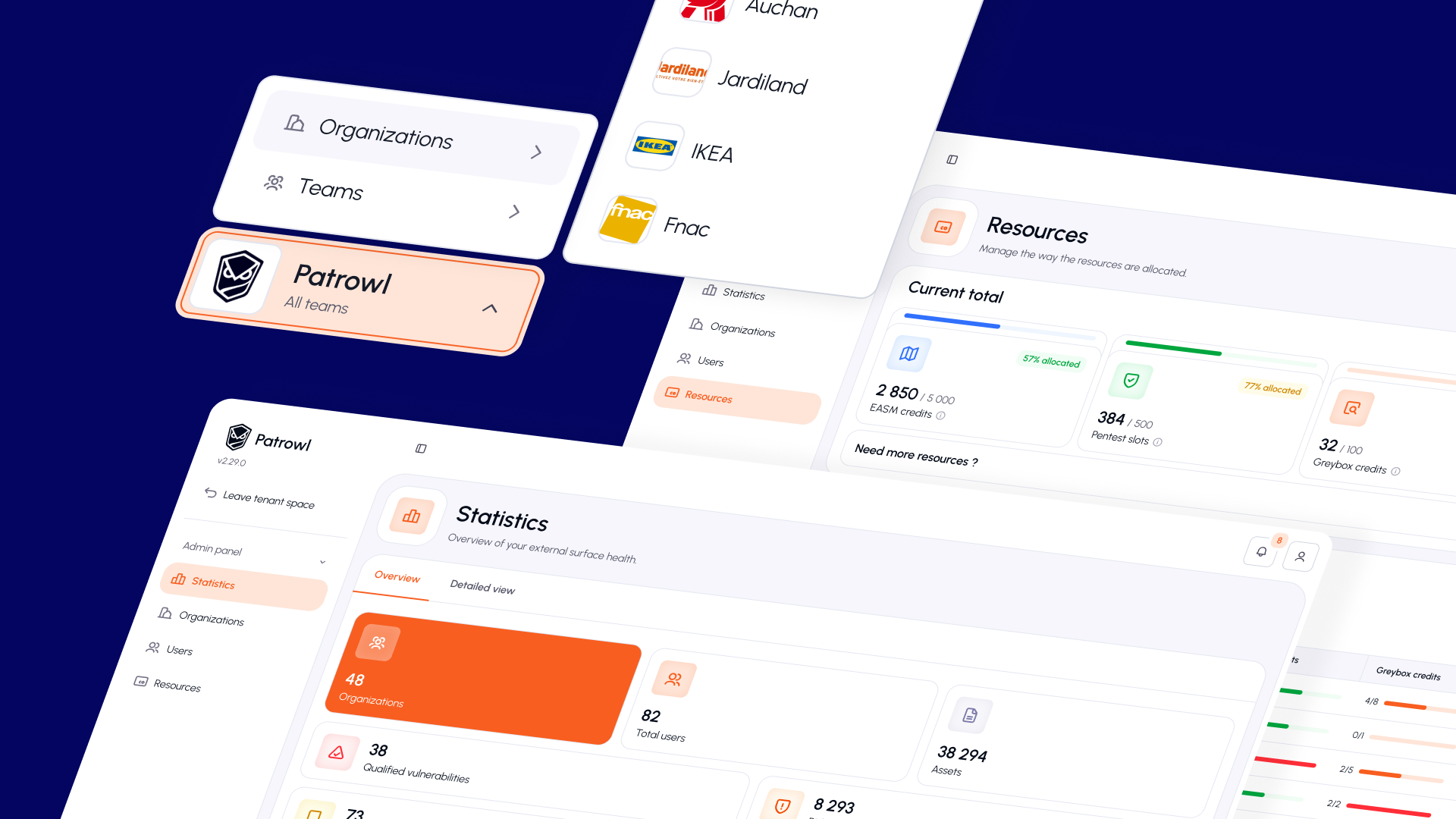
Patrowl Intel platform screenshot